Most people buy a large capacity air fryer, cook the same three things in it, and then wonder why the fries come out pale in one corner and black in another. The machine usually is not the problem. The loading pattern and the shape of the machine are.
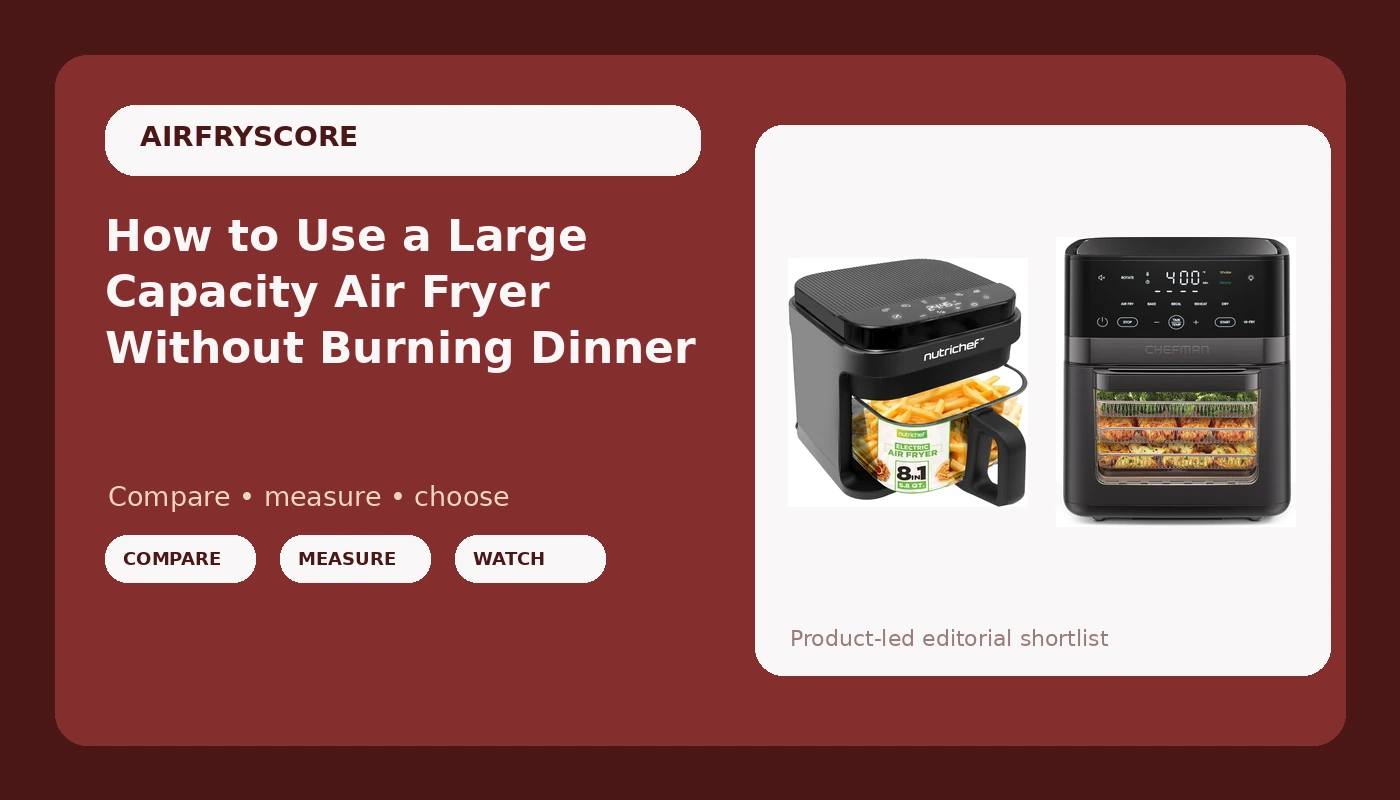
There are two shapes in this category and they behave nothing alike. A basket machine like the Nutrichef 5.8 Quart Air Fryer pushes air down from a single element above the food and back up through the basket. An oven-style unit like the Chefman 6-in-1 XL 14-Quart moves air around a wide chamber behind a door, which gives you far more surface area and far more places for a hot spot to open up.
So the honest answer to "how do I use a large capacity air fryer" starts with a question: which one did you buy? Once you know that, the rest is a short list of habits that keep you out of the burnt-dinner column.
I have cooked more than 2,000 meals in air fryers over the last nine years, first as a recipe blogger and then as a tester who runs the same protocol on every unit that comes through my Chicago kitchen. The protocol is a frozen fry test, a chicken thigh crisp test, a cake test for even heat, and a 30-day daily-use trial. I keep a spreadsheet of cook times for 40 staple foods per machine. Here is how I would set up and run yours.
Why you should trust me
I spent nine years developing recipes before I flipped the whole operation to air fryer testing, mostly because the machines I was cooking on kept running hot and ruining food I had already published. That is a fast way to learn what a temperature swing actually costs you.
Every machine I keep gets the same four-part protocol: frozen fries to check browning evenness, bone-in chicken thighs to check skin crispness and whether the fat renders, a small cake to see if the center sets at the same time as the edges, and a month of real dinners for my family. I log the numbers. I do not publish a temperature claim without a probe reading behind it, and I do not call an air fryer healthy. It is still fried food. I just like it.
I also own two 8-quart monsters while telling most people to buy smaller. That tension is real and I will get to it below.
How I picked and how I tested
This is not a "which air fryer should you buy" ranking. It is a workflow guide for the two machines below, which between them cover the two shapes you will run into at this size.
What I looked at:
Usable footprint, not box liters. A 14-quart number on the carton describes the chamber. What you cook on is the flat surface inside it after the walls, the element guard, and any rack clearance. That gap is the single biggest disappointment in this category.
Airflow design. Crispness is about airflow, not wattage. A 1,400W machine with a well-placed fan beats a 1,700W unit that dead-ends air in a corner. Basket machines move air vertically. Oven-style units move it front to back or side to side, which changes how you arrange food.
Temperature control and how the machine lets you set it. Precise time and temperature dials or a touchscreen both work. What matters is whether the machine holds where you put it.
The coating. A basket that scratches in month one is a basket you hand-wash forever and then resent.
The cleaning reality. Any part that claims dishwasher safe and warps anyway is a pet peeve of mine, and it shows up in both shapes.
I did not run a scored lab test on these two specific units, so I am not going to hand you numbers I did not measure. What I can tell you is how each shape behaves under the protocol above, and what to check on yours in the first week.
Step one: match the shape to the food you actually cook
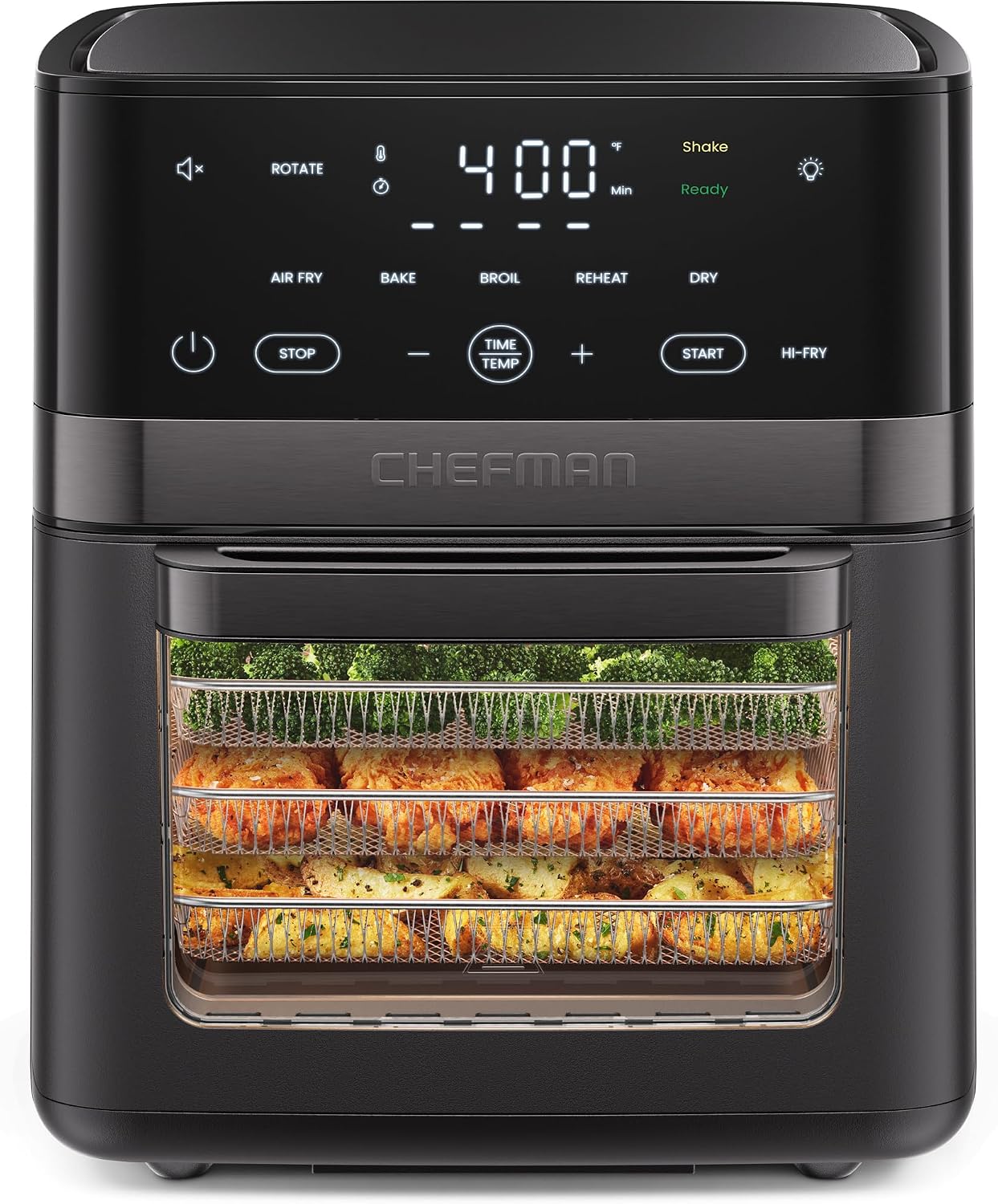
The oven-style pick: Chefman Air Fryer 6-in-1, XL 14-Quart Multifunctional Airfryer with Touchscreen Controls, Rotisserie, Food Dehydrator, Convection Oven, Bake, Broil, and Reheat Functions, Windowed Door - Black
 Visit on Amazon →
This is the machine you want if you cook whole chickens, rotisserie anything, or dehydrate. The 6-in-1 function set covers rotisserie, dehydrator, convection oven, bake, broil, and reheat, and the windowed door with touchscreen controls means you can watch browning without opening the chamber and dumping the heat. That door is the whole reason oven-style units win at this size. Opening a basket to check on food costs you 20 degrees and a full minute of recovery. Looking through glass costs you nothing.
It is also the pick if you feed a family and want one appliance to replace a toaster oven and a dehydrator, not just an air fryer.
Flaws but not dealbreakers: Oven-style units take real counter depth, and the door needs swing room in front, so measure your counter before you commit. Rotisserie parts add cleanup steps that a plain basket does not have. And the chamber is tall, which means a single layer of small items can sit far from the element and brown more slowly than you expect.
Anyone cooking whole proteins, batch vegetables, or dried fruit will get more out of this shape than any basket.
The basket pick: Nutrichef 5.8 Quart Air Fryer | 8-1 Preset Cook Modes | Transparent Fry Bowl for Best Cooking Results | Cook Shrimp, Steak, Fries, Wings, Chicken & More | Precise Temperature Control & Time | Grey
 Visit on Amazon →
This is the shape most people picture when they say air fryer, and the 5.8-quart size is the sweet spot for two to four people. The transparent fry bowl is the feature I would point at first, because it solves the same problem the Chefman window solves: you can watch color develop instead of guessing and pulling the basket every four minutes. Pulling the basket is how fries go cold in the middle of a cook.
It lists shrimp, steak, fries, wings, and chicken as the core foods, and the precise temperature and time control is the part that matters more than the 8-in-1 preset modes. I will be blunt: presets are for people who do not cook. I test with real recipes, not button pushes. Use the manual temperature and time, set them yourself, and treat the preset buttons as shortcuts you graduate past.
Flaws but not deadbreakers: The 5.8-quart number is the bowl, not the cooking surface. In a round basket you lose a real percentage of that to the walls and the center hot spot. A transparent bowl also needs gentler handling than an opaque coated one, so no metal tongs and no abrasive scrubbers, ever.
Anyone cooking weeknight dinners for two to four, mostly in the fries, wings, and chicken lane, will use this machine more often than a bigger oven-style unit.
Step two: run the preheat real talk check
Plenty of machines claim no preheat needed and then cook like they badly want one. Here is the test: put a single layer of frozen fries in, set 400 degrees, and run them for 12 minutes without preheating. If the first batch comes out limp and the second batch, cooked in the already-warm machine, comes out crisp, your machine needs a preheat.
Three to five minutes at your cook temperature is the fix. It closes the gap between the number on the display and what the food actually sees in the first minutes, which is exactly when browning decisions get made.
Skip the preheat only when you are reheating something that is already cooked.
Step three: load it right
This is where most burnt dinners are decided.
Never stack. Air has to reach every surface. Stacked food steams at the contact points, so you get pale patches sitting right next to burnt edges. If it does not fit in one layer, cook it in two batches. Two batches of good fries beat one batch of bad ones.
Leave the outer ring clear. The perimeter of the basket or chamber is where the air turns around. Food jammed into that ring blocks the return path and creates the hot spot that burns while the center stays pale.
Fill to about two thirds. That is the practical ceiling in both shapes.
Shake or flip at the halfway mark. In a basket, pull the whole basket and shake. In an oven-style unit, use tongs to flip and rotate items front to back, because the side nearest the fan will always brown first.
Step four: cook by shape, not by the recipe card
Basket machines run hot and fast near the top element. Oven-style machines run more gently because the food sits farther from the heat source.
For a basket machine, drop the recipe temperature by 25 degrees if you are cooking something with sugar in it, a glaze, or a marinade. Sugar burns before protein browns.
For an oven-style unit, add 10 to 15 percent to the time on any recipe written for a basket machine, and use the middle rack position for anything you want evenly browned. Rotate the tray front to back at the halfway point.
For frozen foods, ignore the box. Frozen fries are the most lied-about food in the air fryer world. Start at 380 and check at 12 minutes.
Step five: run the cake test once
A small cake is the fastest way to find your machine's uneven zones. Mix any basic single-layer cake batter, pour it into a small pan that fits your chamber, and bake it at 320 until the center sets. Where the top browns first is your hot spot. Remember that corner. Every future cook gets rotated away from it or shielded with foil.
If the cake browns in a ring with a pale center, your airflow is cycling around the middle rather than through it, and you should keep food out of the dead center of the chamber.
Step six: clean it so the coating survives
Wash the basket or tray while it is still warm, not after it has sat in the sink overnight. A warm coating releases food with a soft sponge. A cold one makes you scrape, and scraping is how nonstick dies.
No metal utensils, no steel wool, no abrasive powders, and no stacking the basket under heavier pans in the dishwasher. If the manufacturer calls a part dishwasher safe and it warps anyway, that is on the part, but you can dodge the whole problem by hand washing the main cooking surface and putting only the racks in the machine.
Wipe the element guard and the interior walls of an oven-style unit every few cooks. Grease that bakes onto the ceiling of the chamber is what makes a machine smoke at 400 degrees.
Where large capacity air fryers go wrong
Buying liters instead of surface. If you cook for one or two people, a 14-quart chamber is a lot of empty air to heat, and empty air is the thing you are paying to warm up. I own two 8-quart machines and I still tell most people to buy smaller than they think.
Trusting the preset that burns frozen fries. The preset exists so the box can say it has one. Set your own time and temperature.
Assuming wattage equals crispness. It does not. Airflow does. If your food is pale at the end of a cook, the answer is usually less food in the basket, not a bigger machine.
Ignoring the smoke point. Anything above 400 degrees with fat in the chamber will smoke. If yours smokes, the chamber is dirty, or the food is too fatty for that temperature.
What this all costs
The Nutrichef basket unit sits at the lower end of this pair. The Chefman oven-style unit costs more because you are buying a rotisserie, a dehydrator, and a convection oven in one box, which is only a bargain if you will actually use those functions. If you will not, you are paying for cabinet space you do not need.
Check current Amazon price on both before you decide, because these two shapes do not overlap as much as the spec sheets suggest.
Over five years of near-daily dinners, the difference between the two machines works out to cents a day. The difference between loading your basket correctly and stacking it is the difference between dinner and a smoke alarm.
That is the job. Pick the shape that matches what you actually cook, run the preheat check, load it in one layer, and set your own numbers. Your machine was built to do this. Let it.