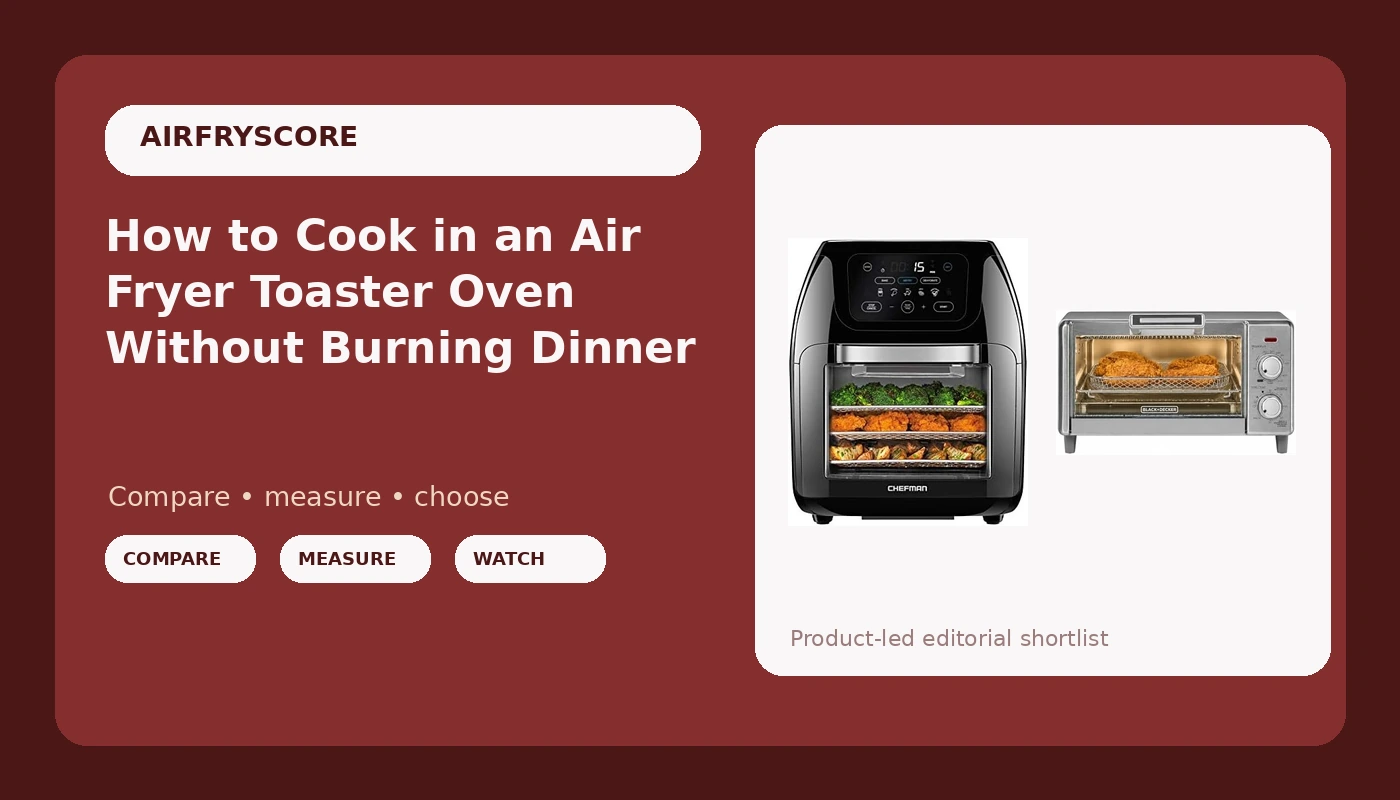
An air fryer toaster oven is not a big basket fryer. It looks like one on the box, it uses the same words on the presets, and then it burns your first batch of fries because the heating elements are six inches from the food instead of two feet. I have watched people give up on a perfectly good countertop oven because they treated it like a basket machine for a week.
The good news is that an air fryer toaster oven is more useful than a basket once you learn its rules. You get a flat rack instead of a bucket, which means more usable footprint for the same counter space, plus toast, plus a bake setting, plus a window you can actually look through. The two machines I keep recommending to people who ask are the CHEFMAN Multifunctional Digital Air Fryer+ and the BLACK+DECKER 4-Slice Air Fry Toaster Oven, and neither one is hard to run once you know the temperature, the rack, and the shake.
This is the version of the guide I give friends who text me a photo of a smoking oven at 9 p.m.
Why you should trust me
I have been cooking in air fryers, basket and oven style, for years, and I keep a spreadsheet of cook times for staple foods on every machine that comes through my kitchen. My house rule is simple: temperature accuracy decides whether a recipe works, not wattage, not preset count, not how big the box says the capacity is. A countertop oven that runs hot by 50 degrees will fail you on a cake and a chicken thigh on the same afternoon, and you will blame the recipe.
I also cook dinner in these things, which is the part that matters. A machine can pass a frozen fry test and still be miserable to live with if the crumb tray is a puzzle or the rack only fits one shape of pan. Every recommendation in this article comes back to one question: would I make my family's dinner in it tonight and not think about it again?
How I picked and how I tested
This is not a buying guide for air fryers in general. It is instructions for running the two machines people are most likely to have on the counter, plus the general rules that apply to any air fry toaster oven.
Both machines get judged on the same four things. First, temperature honesty: does the number you set match the heat the food receives, or does the machine drift? Countertop ovens have a real advantage here because the elements cycle against a thermostat with more air volume to buffer them, but they also have a real disadvantage because the top element is close enough to blacken a piece of bread in 40 seconds. Second, usable footprint. Box liters are marketing. What matters is how much flat rack you get after you account for the door swing and the walls. Third, coating durability: a rack and tray that scratch by month three turn every cook into a foil-lining chore. Fourth, daily friction: does the door close, does the tray slide, does the window stay clear enough to be worth having.
The two models below land on opposite ends of that list. One is a full-size family oven with rotisserie and dehydrate modes. The other is a compact toaster replacement that happens to air fry. Both are honest about what they are, which is why they are here.
The two machines this guide is built around
The instructions further down work on either one, but the numbers and the rack notes differ, so here is what you are working with.
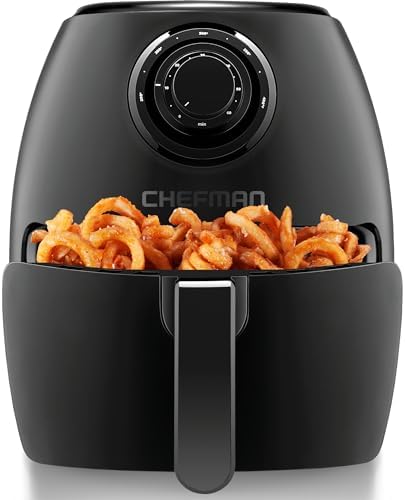
Our pick: CHEFMAN Multifunctional Digital Air Fryer+ Rotisserie, Dehydrator, Convection Oven, 17 Touch Screen Presets Fry, Roast, Dehydrate, Bake, XL 10L Family Size, Auto Shutoff, Large Easy-View Window, Black
 Visit on Amazon →
This is the machine for a household of four or more, or for anyone who wants a countertop oven to do the work of a second oven. The XL 10L family size gives you a flat rack plus room for a rotisserie basket, which is the single biggest functional difference between an air fry oven and a basket fryer. You can air fry a whole chicken on the spit, roast vegetables on the rack underneath it, and catch the drippings in the tray. No basket machine does that.
The 17 touch screen presets are a mixed bag in the way all presets are. Fry, Roast, Bake, and Dehydrate are worth having as starting points because they pick a reasonable temperature for you. The rest are shortcuts I would rather set manually, because preset programs cannot know your food's thickness. The Large Easy-View window and Auto Shutoff are the two features I would keep if I had to cut everything else: the window means you check browning without dumping heat out the door, and Auto Shutoff means a forgotten batch of jerky does not become an event.
Flaws but not dealbreakers: Big. This is a family-size footprint and it will eat counter space next to a coffee maker. Measure before you commit. The presets also lie by omission, since they do not tell you to shake at the halfway mark.
Anyone feeding a family, or anyone who wants rotisserie and dehydrate in the same box, should start here.
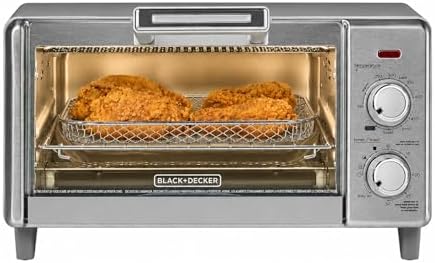
Compact pick: BLACK+DECKER 4-Slice Air Fry Toaster Oven, 5-in-1 Countertop Oven
 Visit on Amazon →
This one earns its spot by replacing a toaster instead of replacing an oven. It is a 4-slice format, so it fits where a full-size air fry oven will not, and the 5-in-1 layout covers the jobs a small kitchen actually asks for: air fry, toast, bake, and the two reheat-adjacent modes people use most. Four slices of bread and a two-person dinner are the design target, and it hits that target.
Here is the honest tradeoff. A 4-slice footprint means a small usable rack, so you are cooking in single layers and often in two batches. That is fine for two people and frustrating for four. If you batch-cook for the week, this is the wrong shape of machine.
Flaws but not dealbreakers: Small capacity means crowding is the default mistake, and crowding is what makes air frying fail. Cook less at a time than feels efficient and the results jump immediately.
Anyone in an apartment, a dorm, or a two-person household who wants toast and air frying from one appliance will get more daily use out of this than out of a bulkier machine.
The actual workflow, from cold oven to crisp dinner
This is the part you came for. The steps work on any air fry toaster oven. The numbers assume the machine above; adjust from there.
Step one: Preheat for five minutes, always. The "no preheat needed" line on the box is about toast and reheating. Anything you want brown, including frozen fries, chicken skin, and roasted vegetables, needs the metal hot before the food lands on it. A cold rack steams the bottom of whatever you put down. Five minutes at your cooking temperature is enough, and the window usually shows you when the element has cycled off the first time.
Step two: Set it 25 degrees lower than the basket recipe. This is the rule that saves the most dinners. A basket fryer recipe written for 400 degrees assumes the food sits in a bucket below the element. In an oven format, food on the top rack is much closer to the top element, so the same 400 browns the surface before the middle cooks. Start 25 degrees lower than the recipe says, then go up at the end if the color is not there.
Step three: Rack position is a decision, not a default. Top rack means maximum browning and minimum margin for error. Middle rack is the safe default for anything thicker than a finger: chicken thighs, pork chops, a small cake. If you are using the rotisserie on the CHEFMAN, the rack comes out entirely so the spit can turn, and you should drop the temperature a bit more, because a rotating bird browns evenly on all sides without needing a hot blast from above.
Step four: One layer, with air gaps. Airflow is what makes this cooking method work. Two layers of fries means the bottom layer is steamed and the top layer is scorched. On a 4-slice rack, that means smaller batches than you want. Do it anyway.
Step five: Shake or flip at the halfway mark. Set a timer for half the total cook time. Shake the rack contents or flip them with tongs. This one habit fixes most uneven browning complaints, because the hot spot in a countertop oven lives wherever the element coil sits closest, and moving the food evens out its exposure.
Step six: Treat the presets as temperature suggestions, not programs. The Fry and Roast buttons on the CHEFMAN are genuinely useful for picking a starting temperature. The 17 preset list is not a set of recipes. If your food is thicker or colder than the preset assumes, the preset will undercook it. Set the temperature from the preset, then run the timer yourself.
Step seven: Use the window instead of opening the door. Every door opening dumps heat and adds minutes. The large easy-view window on the CHEFMAN exists for exactly this. If your machine does not have one, learn the smell of "almost done" and trust the timer.
Step eight: Empty the crumb tray after every cook. Not weekly. Every time. Grease that bakes onto a tray for three days turns into smoke at high heat, and smoke is the number one reason people decide their air fryer is broken.
Three mistakes that ruin food in an oven-style air fryer
Crowding the rack. A flat rack looks like it holds more than a basket, and it does, but only in one layer. Fill it edge to edge and you have built a steamer.
Cranking the temperature to speed things up. Higher heat does not shorten the cook, it just moves the burn earlier. If something is browning too fast and the inside is raw, drop the temperature 25 degrees and add time. That is almost always the fix.
Skipping the flip on anything with fat. Chicken thighs, sausage, bacon, and anything skin-on will pool rendered fat on the underside. Flip it once and drain the tray if the pool gets deep.
The competition and why it lost
Basket air fryers are not the enemy here, they are a different tool. If your priority is the crispiest possible frozen fries in the shortest time, a basket machine with strong airflow will still win, because the food sits in a perforated bucket with forced air moving around all of it. That is a real advantage and I will not pretend otherwise.
Where baskets lose is everything else. You cannot bake a cake in a basket. You cannot run a rotisserie. You cannot toast four slices of bread and pull them out with your fingers. You cannot look through a window at what is happening without opening the machine. For a lot of kitchens, the oven format replaces two appliances instead of one, and that is why it made this guide and the basket did not.
Full-size wall ovens are the other comparison, and they win on capacity every time. They lose on preheat time, on energy for small batches, and on how often you use them at all. A countertop air fry oven that gets used nightly beats a wall oven that gets used on Sundays.
What this all costs
Both machines sit in the range you would expect for their size, so the question is not which is cheaper, it is which footprint your kitchen can absorb. Check current Amazon price on each and do the comparison against whatever it replaces. If it replaces a toaster and a microwave reheat habit, a compact unit pays for itself faster than the big one, because the big one only pays off if you actually use the extra rack.
The cost-per-day math over two years is the useful lens. Divide the price by 730 days. That is the number to weigh against a takeout order you avoided, which is usually the honest comparison for a countertop appliance that gets used five nights a week.
The short version
Preheat five minutes. Set it 25 degrees below the basket recipe. Middle rack for thick food, top rack for things you want browned. One layer, always. Shake or flip at halfway. Empty the tray every single time. Follow those six lines and any air fryer toaster oven becomes a machine you trust, including the two above.
The settings are the easy part. The habit of not crowding the rack is the whole game, and it takes about a week to stop making that mistake.