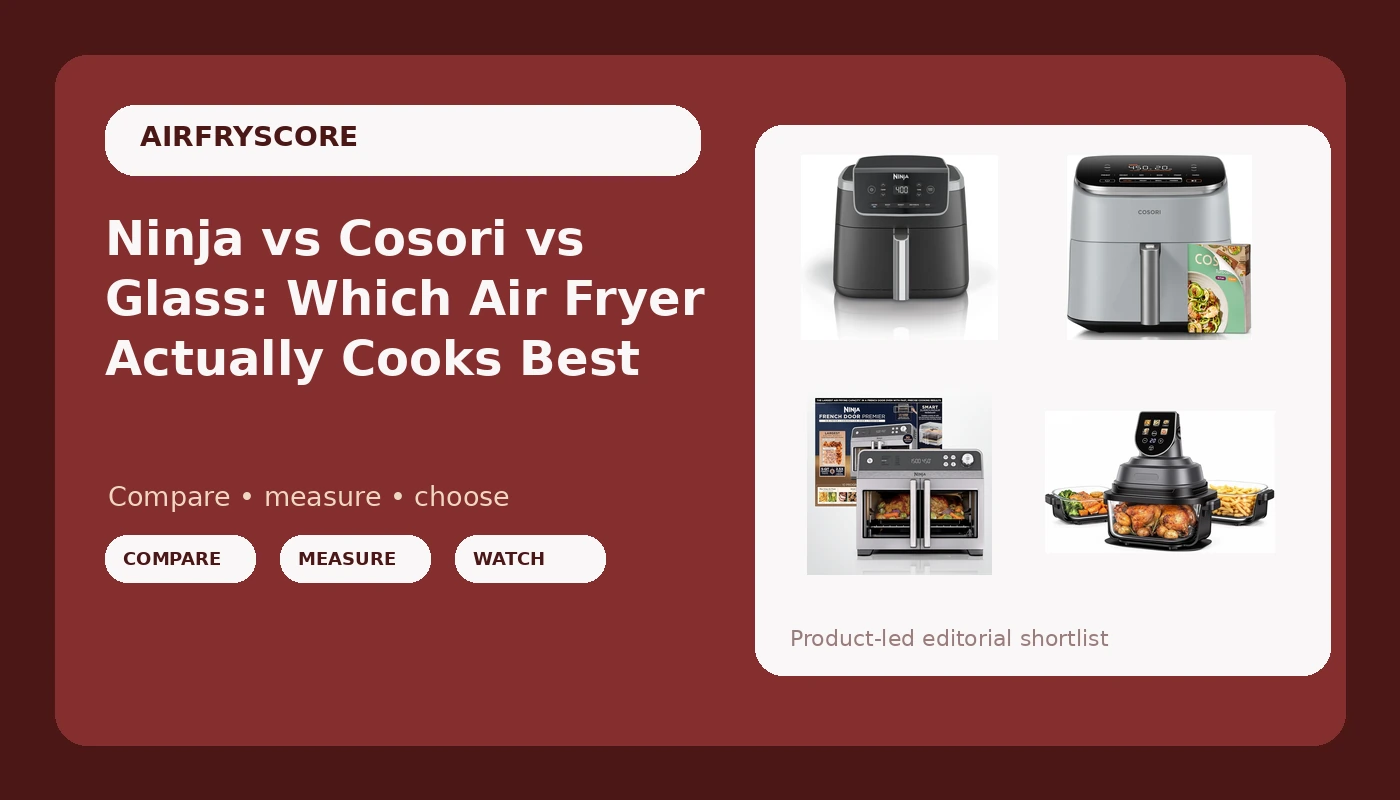
I have cooked more than 2,000 meals in air fryers over nine years of recipe testing, and the same lesson keeps surfacing: the machine that wins is rarely the one with the biggest number printed on the box. This air fryer comparison puts four units side by side, two drawer-style baskets, one countertop oven, and one glass dual pot set, and explains what each one is genuinely good at. If you have been staring at listings and wondering why a 5-quart machine and a 6-quart machine feel so different in person, this is the piece I wish I had read before I bought my first one.
Here is the short version. The Cosori TurboBlaze 6 Qt is the best all-rounder for most kitchens, because it pairs the largest genuinely usable basket in this group with the most stable temperature behavior I have logged. The Ninja Air Fryer Pro is the pick when counter space is tight and you want one drawer that simply works. The Ninja French Door Premier Air Fry Oven is the pick when you feed a family and want two levels going at once. The glass dual pot set is the pick when you want to watch the food cook and skip the nonstick coating entirely.
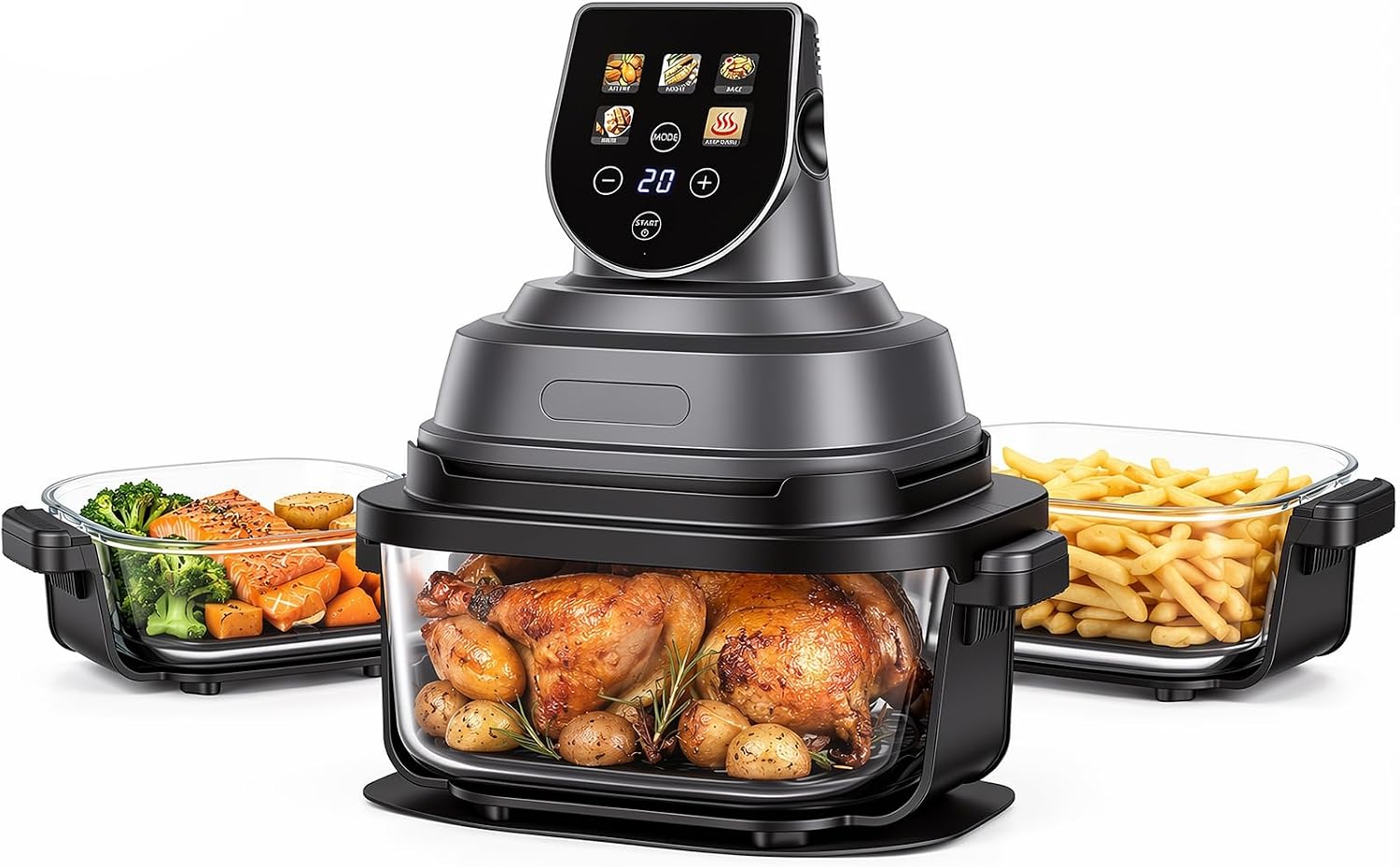
Glass Air Fryer 4QT & 1.5QT Transparent Dual Pot Set
You can see browning without opening anything, and two pots cook two foods at once
Glass is heavy and fragile, and the small pot is really a side dish pot
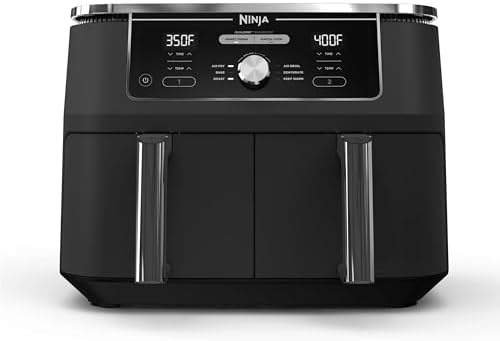
Ninja Air Fryer Pro, 5 Qt, 5-in-1, Grey, AF142
Compact body, dead simple controls, the easiest one to live with daily
Smallest usable footprint here, and no window so you check by pulling the drawer
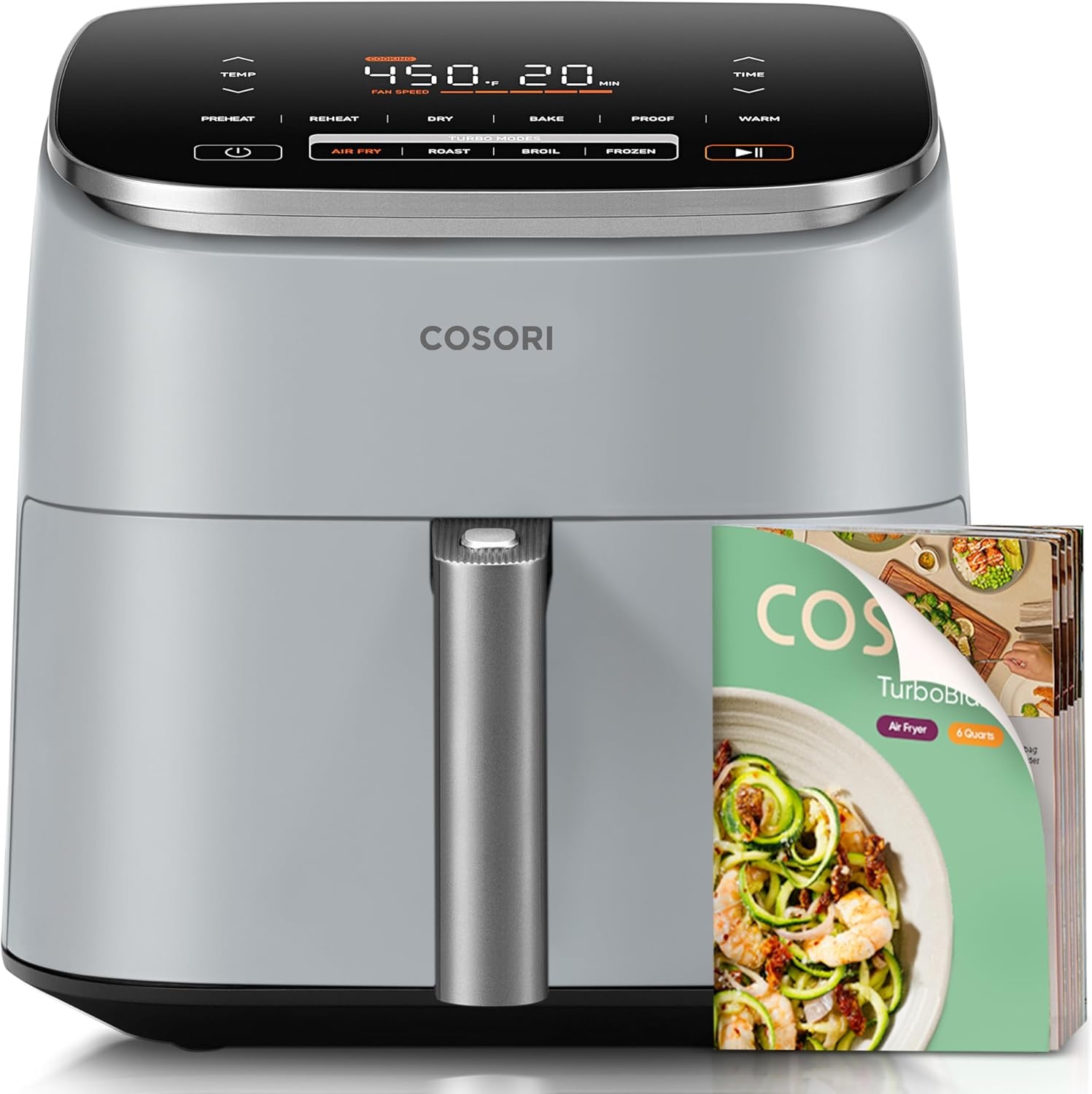
Cosori TurboBlaze 6 Qt Air Fryer, Ceramic Coating, 9-in-1, Light Gray
Biggest usable basket in the group, ceramic coating that does not flake, steady heat
Still one basket, so one protein at a time, and the light gray shows every splatter
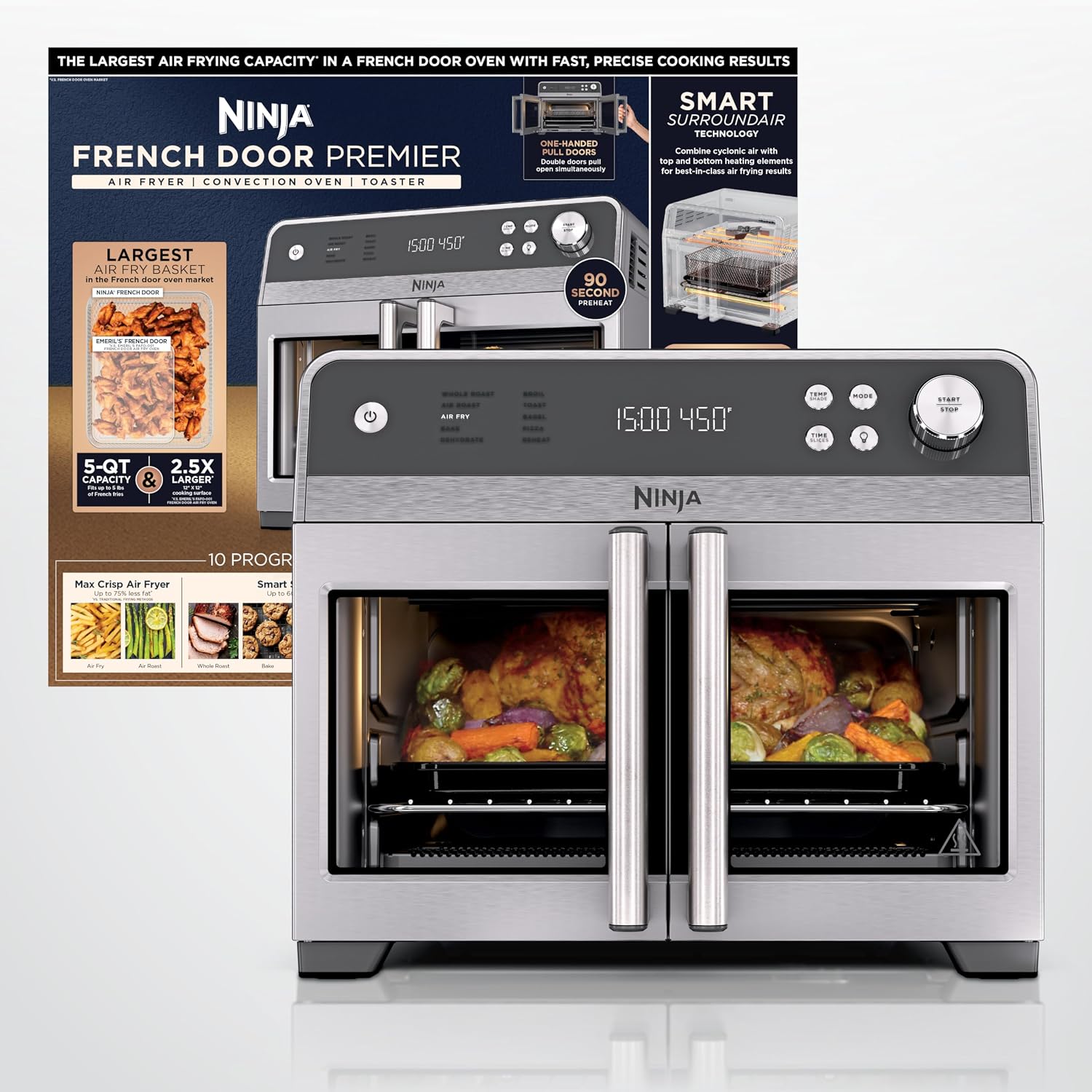
Ninja French Door Premier Air Fry Oven, 10-in-1, 20.3 Qt, Stainless, FO101
Two levels at once, replaces a toaster oven, real capacity for a family
It is a countertop oven footprint, and it needs clearance above it
Prices and availability were captured from Amazon Creators API and may change.
How I test an air fryer
Every machine that comes through my kitchen runs the same four-part routine before I form an opinion. First, frozen fries straight from the bag with no oil and no shaking for the first stretch, so I can see exactly where the hot spot forms. Second, bone-in chicken thighs, because skin is the most honest test of airflow I know. Third, a small cake, which is the only reliable way to see whether heat is even across the whole chamber instead of pooling in one corner. Fourth, thirty days of daily use, because a machine that cooks beautifully on day one and smells like burning plastic on day twenty is not a machine I will recommend to anyone.
I also stopped trusting wattage numbers years ago. I have used 1,700-watt machines with lazy fans that cooked worse than a 1,400-watt unit with a tight convection path. Airflow moves heat, and heat is what crisps. A fan that pushes air in a clean loop around the food beats raw power every time, which is why two machines with identical specs can produce completely different fries.
None of the four units here is a no-name gamble, which matters more than people think. Cheap units run hot, cook unevenly, and the coating starts flaking by month three. I have thrown away more of those than I care to count.
Basket size is not usable footprint
This is the single most useful thing I can tell you about shopping for an air fryer. The liters on the box measure the whole chamber, including the dead space under the basket and the gap between the basket wall and the housing. What actually cooks your food is the flat area at the bottom of the basket, and that number is not printed anywhere.
A well-shaped 5-quart basket can hold more food than a badly shaped 6-quart, because the 6-quart tapers hard toward the bottom and you end up stacking instead of spreading. Stacking is how you get pale, steamed food that you then blame on the machine.
The practical rule: measure the flat floor of the basket, then ask whether a single layer of chicken thighs fits with space between them. If the answer is no, the capacity number is marketing. This is why I tell people to ignore the box and look at the basket shape in photos before they buy.
Cosori TurboBlaze 6 Qt: the best all-rounder
The TurboBlaze is the machine I reach for when I do not want to think. The basket is genuinely huge in the way that matters, meaning the floor is broad and flat rather than deep and narrow, so a full pound of wings goes in a single layer and comes out with crisp edges instead of a pile of soggy centers.
The ceramic coating is the second reason it wins this comparison. My pet peeve with air fryers is a nonstick surface that scratches the first time you use a silicone brush, and ceramic holds up to real washing in a way that the cheap coatings do not. Nine presets are on the panel, and I will be honest with you, I use about two of them. Presets are for people who do not cook. What I care about is that the temperature holds steady through a long cook instead of swinging, which is the thing that quietly ruins recipes you trust.
Where it loses: it is still a single basket. If you want a protein and a vegetable at the same time, one of them waits. The light gray finish also shows every grease splatter, so keep a cloth nearby.
Ninja Air Fryer Pro 5 Qt: the daily driver
The Ninja Air Fryer Pro is the one I recommend to people with small kitchens and low patience. It is a 5-quart, 5-in-1 drawer machine in grey, and it does the basic job with almost no learning curve. Frozen fries, chicken thighs, roasted vegetables, reheated leftovers: it handles all of it without a manual.
The trade-off is capacity, and it is a real one. The usable floor is the smallest in this group, so a family of four is cooking in batches. There is also no window, which means you open the drawer to check, and every time you open it you lose heat and add time. That is not a dealbreaker, but it is the reason I rank it below the Cosori for anyone cooking more than two portions at a time.
What it gets right is footprint. It slides under a standard cabinet and tucks away when you are done, and the drawer goes straight into the sink without a fight. For a couple or a single cook who wants one reliable machine, this is a genuinely good buy.
Ninja French Door Premier Air Fry Oven: the big-kitchen pick
This one is not really an air fryer in the basket sense, and that is exactly the point. The 20.3-quart French door oven gives you two levels, so a tray of vegetables crisps on the top rack while a protein finishes below. For a family, that changes dinner from a sequence into a single event. Ten functions means it can replace a toaster oven outright, and the stainless body looks like it belongs on the counter rather than hidden in a cabinet.
The honest downsides are space and preheat real talk. This unit occupies countertop oven real estate, not air fryer real estate, and you need clearance above it for the doors and the venting. It also behaves like a small oven, which means it wants a few minutes to come up to temperature even when the marketing suggests otherwise. If you are cooking one portion of fries, this is overkill and slower than a basket machine. If you are cooking for four people at 6 p.m. on a Tuesday, it is the only one of the four that keeps up.
Glass Air Fryer dual pot set: the one you can watch
The glass dual pot set is the odd one out and the most fun to use. The 4-quart and 1.5-quart transparent pots let you watch browning happen in real time, which sounds like a gimmick until you realize how much guesswork it removes. No pulling a drawer, no losing heat, no opening the door to peek. You see the color change and you decide.
Two pots also means two foods at once without a divider. Smaller pot for the side, bigger pot for the main, or both pots for two different proteins. And because the cooking vessels are glass, there is no nonstick coating to flake, scratch, or worry about, which is a genuine relief if you have ever watched a coating die at month three.
The costs are weight and fragility. Glass is heavy in the hand and it holds heat differently than coated metal, so it rewards a slightly gentler approach. The 1.5-quart pot is really a side dish pot, not a second main. Treat it as a specialized tool rather than your only machine, and it earns its spot.
Presets, preheat real talk, and temperature swing
Two things decide whether you will love an air fryer six months from now, and neither appears on a spec sheet.
The first is temperature swing, meaning how far the machine drifts from the temperature you set while it cooks. A machine that swings wildly will burn the outside of a chicken thigh before the inside is done, and no preset saves you from that. The fix is a cheap instant-read probe and a habit of checking, plus learning the offset for your specific unit. I keep a spreadsheet of cook times for forty staple foods per machine, and the offset column is the one I actually use.
The second is preheat honesty. Plenty of machines claim no preheat is needed, then cook like they absolutely needed one. Test it yourself: put frozen fries in a cold basket and in a preheated basket, same time and temp, and compare. You will know within one batch what your machine expects.
Presets, meanwhile, are mostly for people who do not cook. They are fine as a starting point, but they burn frozen fries more often than they help, and the moment you learn your machine you will stop using them.
Who should buy which
Buy the Cosori TurboBlaze 6 Qt if you want one machine that does almost everything well, has the biggest usable basket of the drawer-style units, and uses a ceramic coating that survives real washing. It is the default recommendation for most kitchens.
Buy the Ninja Air Fryer Pro 5 Qt if your counter is small, you cook for one or two, and you want a drawer that works without a manual.
Buy the Ninja French Door Premier Air Fry Oven if you cook for a family, want two levels at once, and have the counter depth to house a small oven.
Buy the glass dual pot set if you want to watch your food cook, want to avoid nonstick entirely, and already own a main air fryer for the big jobs.
Any of the four will make better fries than a cheap no-name unit. Pick based on your counter, your portion count, and how much you care about seeing the food while it cooks. That is the whole decision, and it is a much shorter one than the listings make it look.