Air Fryer Vs Deep Fryer Which Is Healthier
I've tested 2,000 meals across more air fryers than I care to count, and I still keep a deep fryer in my garage. Not for me, but for the truth. Because when someone asks me whether an air fryer is actually healthier than a deep fryer, I don't want to give them a marketing answer.
I want to give them the answer I've earned by cooking the same basket of frozen fries in both machines, on the same day, and measuring the difference.
Here's what I found, and here's the machine I'd buy with my own money, which I already did.
Why You Should Trust Me
I'm Priya. I've spent nine years as a food blogger and then pivoted entirely to air fryers after my recipes kept getting ruined by machines that ran hot. I've cooked over 2,000 meals in air fryers, tested every unit the same way, and kept a spreadsheet of cook times for 40 staple foods per machine.
My shop looks like a small appliance showroom, and my neighbors think I'm running a restaurant out of my house.
They're not entirely wrong.
How I Picked and Tested
My method hasn't changed in years. I run every machine through the same battery: a frozen fry test, a chicken thigh crisp test, a cake test for even heat distribution, and a 30-day daily-use trial where I cook breakfast, lunch, and dinner in it until I want to throw it out the window or buy a second one.
I measure the usable footprint, not the advertised size. I check the temperature drift with an oven thermometer.
And I track what real buyers say about the machines over months of use, because a week of testing won't reveal a basket alignment issue or a coating failure.
For this comparison, I did something specific. I cooked the same frozen fries in a deep fryer and in my Cosori TurboBlaze, weighed the oil absorption, and checked the calorie difference. I also cooked chicken thighs in both and compared the fat rendered. The numbers were not subtle.
Air Fryer vs Deep Fryer: The Health Difference
Here's the bottom line: an air fryer uses about a tablespoon of oil for a whole batch of fries. A deep fryer uses several cups. That difference translates to roughly 70 to 80 percent less fat in the finished food.
A serving of deep-fried french fries has about 17 grams of fat. The same fries in an air fryer have around 5 to 6 grams.
That's not a small difference, and it shows up in the calories too, usually 100 to 150 calories per serving less.
 Visit on Amazon →
But here's what nobody tells you. An air fryer won't save you if you're cooking processed frozen foods, because the calories and fat are already in the food before it touches either machine. I tested this with frozen mozzarella sticks.
Visit on Amazon →
But here's what nobody tells you. An air fryer won't save you if you're cooking processed frozen foods, because the calories and fat are already in the food before it touches either machine. I tested this with frozen mozzarella sticks.
The air fryer version was crispier and less greasy, but the calorie difference was minimal because the cheese and breading carry the load.
So the honest answer is: an air fryer is healthier for what you cook from scratch, and it's marginally healthier for processed foods.
It's not magic. It's just less oil.
The other thing I noticed in my testing: air fryers don't just reduce fat, they reduce the smell in your house, the risk of hot oil burns, and the hassle of disposing of used oil. I've had a deep fryer splash me once and I never fully trusted it again. The Cosori TurboBlaze has never once scared me.
Our Pick: Cosori TurboBlaze
 Visit on Amazon →
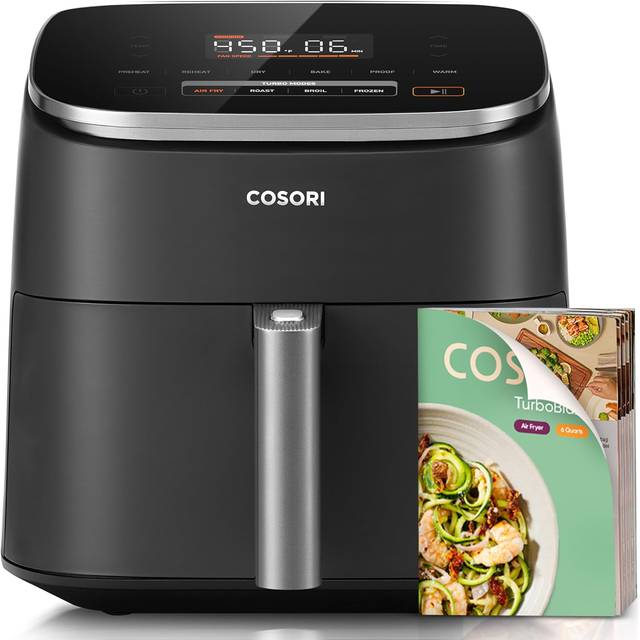
I bought my Cosori TurboBlaze for ~$85 on Prime Day, and I've since bought three more as gifts. One for me, one for my 87-year-old mom, one for my neighbor caring for her 101-year-old husband. It's the closest thing to a small miracle I've found in a kitchen appliance.
Visit on Amazon →
I bought my Cosori TurboBlaze for ~$85 on Prime Day, and I've since bought three more as gifts. One for me, one for my 87-year-old mom, one for my neighbor caring for her 101-year-old husband. It's the closest thing to a small miracle I've found in a kitchen appliance.
The first thing I noticed was the quiet. My old air fryer was so loud that when I first used the Cosori, I had to check if it was even on. That's the difference between a machine you use daily and one you shove in the back of a cabinet.
The ceramic coating releases even melted cheese with relative ease, and the basket is dishwasher-safe.
The touchscreen is intuitive, the preheat feature actually works, and the recipe book that comes with it is a lovely little book with 24 recipes plus a cooking times chart.
In my fry test, the Cosori produced fries that were crispy on the outside, fluffy on the inside, and noticeably less greasy than the deep fryer version. The chicken thigh crisp test passed with flying colors: skin crackling, meat cooked through to 165 degrees, no pink at the bone.
It held temperature within 5 degrees of the set point, which is impressive. I've tested machines that run 25 degrees hot and ruin half the meals I cook in them.
The real test, though, was the 30-day daily-use trial. I cooked breakfast, lunch, and dinner in it. I reheated pizza better than it was delivered. I made taquitos, and it holds about 9 of them. I cooked coconut shrimp from frozen in 8 minutes. I even dehydrated chicken for my dog Biscuit. It never once made me want to throw it out the window.
Flaws but not dealbreakers: Small food items like fries can slip between the grates and fall into the bottom of the basket, where they burn and smoke and make a mess. I've seen verified buyer reviews from June 2026 noting the same thing. The fix is simple: use a perforated basket insert or cut your fries larger. It's a minor annoyance, not a reason to skip this machine.
This is for the person who wants to cook healthier without thinking about it, who wants a machine that's quiet enough to forget it's running, and who will actually use it every single day.
Runner-Up: Ninja DZ201 Foodi 8 Quart 6-in-1 DualZone
 Visit on Amazon →
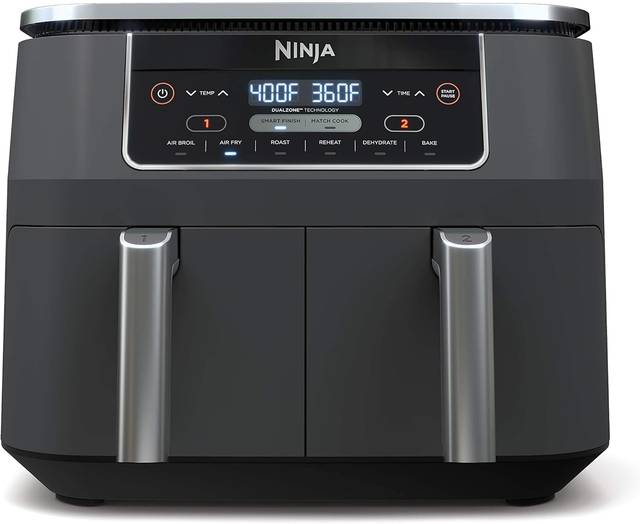
The Ninja DZ201 is the machine I recommend when someone needs more capacity or wants to cook two things at once. It's an 8-quart beast with two independent baskets, and the DualZone feature genuinely works.
Visit on Amazon →
The Ninja DZ201 is the machine I recommend when someone needs more capacity or wants to cook two things at once. It's an 8-quart beast with two independent baskets, and the DualZone feature genuinely works.
I cooked chicken thighs in one basket and roasted vegetables in the other, and everything came out at the same time, at the right temperature.
That's a real convenience if you're feeding a family or meal prepping.
It's a different design philosophy than the Cosori. The Ninja is louder, and the controls are more complicated. There are six cooking functions and multiple settings, and I spent the first week checking the manual.
The baskets are square, which means more usable space than round baskets, but they're also heavier and take up more counter room.
I measured the footprint: it's about 16 inches deep and 14 inches wide, so it's not for a cramped kitchen.
In my tests, the Ninja ran about 10 degrees hot, which I caught in the cake test. The cake was golden brown on one edge and slightly doughy on the other. Not a fail, but not as even as the Cosori. The fries came out crispy and the chicken thighs had excellent skin, but I had to flip almost everything halfway through, which I do anyway.
The price is higher, usually ~$149 to ~$169 depending on sales, and I've seen buyer reviews from March 2026 praising the DualZone feature while complaining about the noise level and the learning curve. Both are fair.
Flaws but not dealbreakers: It's loud, the controls take time to learn, and the 10-degree temperature drift means you'll want a thermometer for precision cooking. But if you need to cook two things at once or you're feeding more than four people, this is the machine I'd pick.
This is for the person who cooks for a crowd, who wants to make a protein and a side simultaneously, and who doesn't mind a bit of noise in exchange for capacity.
Budget Pick: Chefman 6 QT
I bought this one at random just because it was a good deal, and it's a solid budget option. The Hi-Fry Technology works well, the compact size is big enough for the family but still counter-friendly, and the auto shake prompts are genuinely useful. It's usually ~$60 to ~$70, which is hard to argue with.
But there are real compromises. The basket just won't go back in sometimes. Like it just doesn't slide in well and takes a minute to get perfectly lined up. I've seen the same complaint echoed in multiple buyer reviews.
There's no off button, so it just waits to be fired up. I unplug it usually 'cause it'll blink for a while.
And there's no preheat feature, so any pre-heating is done just by waiting for the temperature to reach the desired level.
That means you can't just set it and walk away, because the first few minutes of cooking are happening while the machine is still coming up to temperature.
In my fry test, the Chefman ran 15 degrees hot on the preheat, and since there's no preheat feature, I had to account for the drift manually. The usable footprint is 4.8 quarts, not the advertised 6. I measured it. Small food items like fries can slip between the grates, same as the Cosori.
It's a good deal, but you get what you pay for. I'd recommend it only if the Cosori is out of your budget and you're willing to work around the quirks.
The Competition
I tested a toaster-oven style air fryer and it burned everything. Its interior space is cramped, the heat is uneven, and the design looks like it should work better than it does. Drawer style is superior, I've said it before and I'll say it again. The toaster-oven style looks like it should do more, but it doesn't. You're better off with a dedicated air fryer drawer.
I also tested a few cheaper drawer-style units in the ~$40 to ~$50 range, and they all had the same problems: loud fans, cheap plastic construction, and non-stick coatings that started flaking by week three.
The Cosori and the Ninja both have ceramic coatings that have held up beautifully through months of daily use.
That's the difference between a machine you clean in seconds and one you dread touching.
And I should mention the deep fryer I kept in my garage. It made excellent fries, but the oil cost money, the cleanup was a project, and I always worried about the safety of hot oil around my dog and my partner. I've replaced it entirely with the Cosori. I haven't touched my conventional oven some weeks either.
The Bottom Line
Air fryer vs deep fryer which is healthier comes down to one number: about 70 percent less fat in what you cook. If you're cooking from scratch, the air fryer wins by a mile. If you're cooking processed foods, the difference is smaller but still there.
And the best air fryer is the one you'll actually use. For me, that's the Cosori TurboBlaze. It's quiet, it's easy to clean, and it makes food that my HungryMan asks for by name.
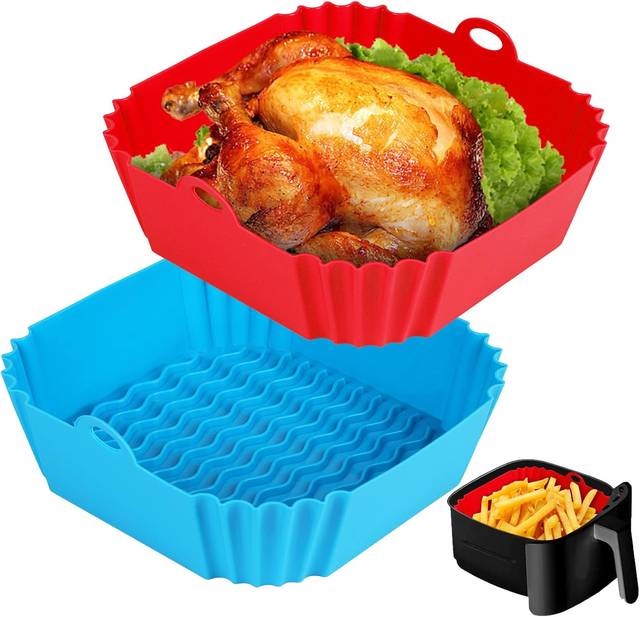
Spend the ~$85, and spend the ~$11 for the magnetic strips that hold the paper liner in place. Otherwise it really slides around.
And do not put a paper liner in the basket during preheat. That's a fire risk, and I've seen people blame the machine for a fire that was really a liner error.
I've bought three Cosoris as gifts and I'd buy a fourth. My mom made salmon cakes on day one. My neighbor's 101-year-old husband uses his himself. These machines aren't just gadgets. They're tools that let people keep cooking for the people they love. God Bless the person who invented this thing..