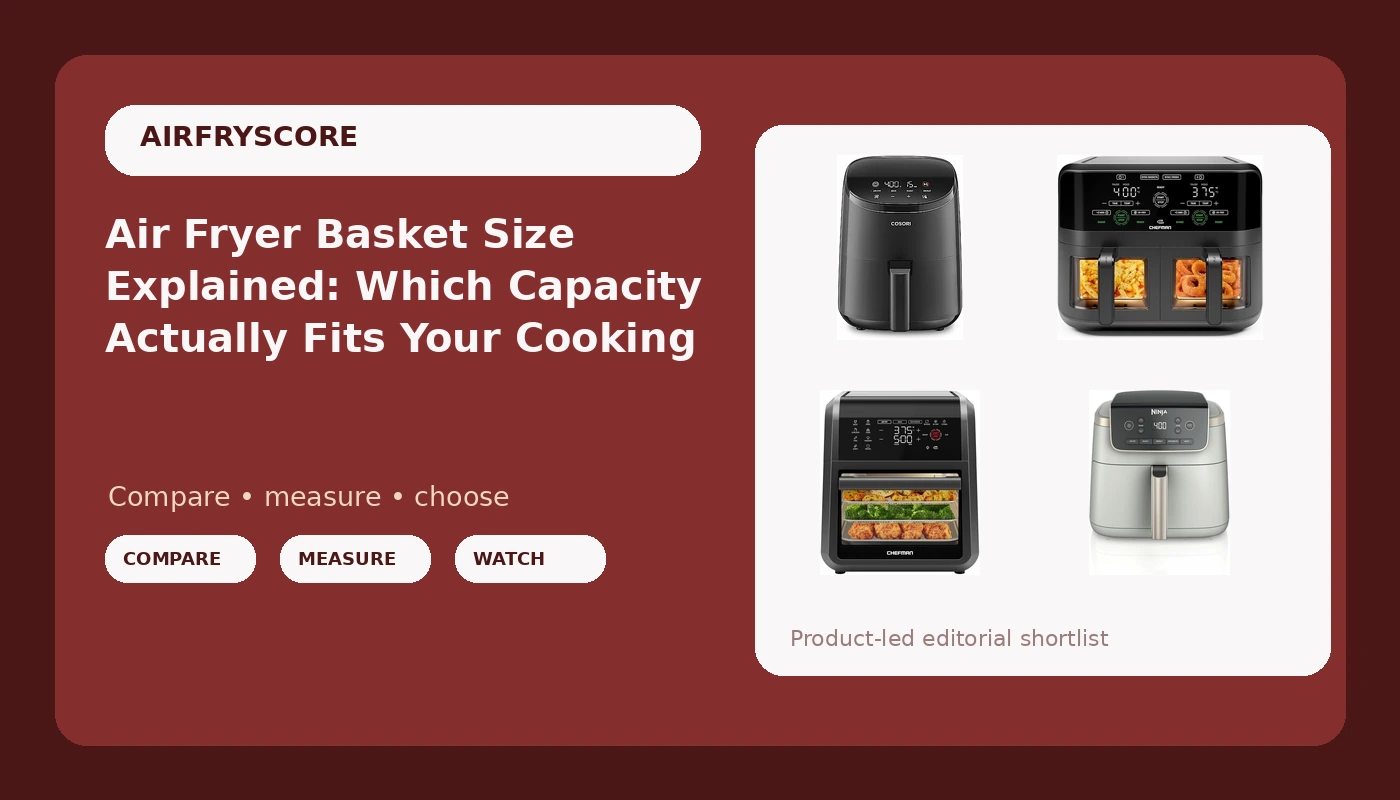
Air fryer basket size is the spec that decides whether a machine earns permanent counter space or gets shoved into a cabinet by February, and it is also the spec most likely to mislead you. The number printed on the box describes interior volume, while the surface you can actually lay food on is smaller, sometimes dramatically so. A 2.1-quart basket and a 12-quart oven-style unit both advertise capacity, but they solve completely different problems: one portion of vegetables versus a full batch for a family. This explainer walks through what air fryer basket size really means, how airflow and temperature accuracy shape your results, and how four current models map to four different kitchens.
Related: Why Your Air Fryer Runs Hot: Temperature Accuracy Explained →
Quick answer
Match the basket to your largest regular cook, not your largest occasional one. For one or two people, a 2 to 3 quart basket covers most weeknight portions. A 5 quart single basket handles two to four people eating the same dish. Two independent baskets or a 12-quart oven-style unit suit households that cook two components at once or batch large quantities. Always weigh usable footprint over box volume, because food needs open air around it to crisp rather than steam.
Four useful options
| Model | Best fit | What stands out |
|---|---|---|
| Ninja Air Fryer Pro, 5 Qt, 5-in-1, Amazon Exclusive Bone & Champagne | Two to four people cooking one main dish | A 5-quart single basket with five cooking functions |
| Cosori Lite 2.1 Qt Small Air Fryer, Max 400°F, 4-in-1, 97% less oil, Gray | One or two people with limited counter space | A compact 2.1-quart basket with a 400°F maximum |
| CHEFMAN 6 Quart Dual Basket Air Fryer Oven with Easy View Windows, Sync Finish, Hi-Fry, Auto Shutoff, 2 Independent 3Qt Nonstick Dishwasher Safe Frying Baskets, Digital Double Air Fryer - Black | Cooking two foods on separate schedules | Two independent 3-quart baskets with Sync Finish |
| Chefman 12-Quart 5-in-1 Air Fryer Oven with Digital Timer, Touchscreen, and 12 Presets - Family Size Countertop Convection Oven, Dishwasher-Safe Parts | Larger households and batch cooking | Oven-style 12-quart chamber with 12 presets |
The everyday five-quart: Ninja Air Fryer Pro, 5 Qt, 5-in-1, Amazon Exclusive Bone & Champagne
Five quarts is the size most people land on after a return or two, and the reason is arithmetic rather than marketing. A basket in that range holds enough for two adults and a child eating the same food, which covers the majority of weeknight dinners. The trade-off is the single basket itself: if one person wants chicken and another wants potatoes at a different temperature, you cook in two rounds. That is a genuine cost in time, and it is the main reason dual-basket machines exist at all. The Ninja Air Fryer Pro pairs its 5-quart basket with five cooking functions, and the Bone & Champagne finish is an Amazon Exclusive colorway rather than a different machine underneath.
The compact single: Cosori Lite 2.1 Qt Small Air Fryer, Max 400°F, 4-in-1, 97% less oil, Gray
A 2.1-quart basket is not a compromise for everyone. For one person in a small kitchen, it is the difference between a machine that lives on the counter and one that lives in a cabinet behind the mixing bowls. The Cosori Lite tops out at 400°F and covers four functions, which is plenty for reheating leftovers, crisping a single portion of vegetables, or cooking two chicken thighs. What it will not do is feed four people at once or hold a whole chicken, and the 97 percent less oil figure is the manufacturer's comparison against deep frying rather than a measurement of how this unit cooks. Buy small only when your largest regular cook is genuinely small.
The two-basket option: CHEFMAN 6 Quart Dual Basket Air Fryer Oven with Easy View Windows, Sync Finish, Hi-Fry, Auto Shutoff, 2 Independent 3Qt Nonstick Dishwasher Safe Frying Baskets, Digital Double Air Fryer - Black
Two independent 3-quart baskets solve the sequencing problem: one side holds the protein, the other holds the side, and Sync Finish is designed to land both at the same time. The Easy View windows let you check progress without pulling a basket out and dumping heat into the room, and Auto Shutoff is the safety net for anyone who wanders off mid-cook. The trade-offs are real. A dual-basket body occupies more counter than a single basket of the same total capacity, and each 3-quart side is smaller than a 5-quart single, so a large batch of fries still has to be split across both sides. The nonstick baskets are listed as dishwasher safe, which matters if this machine is going to run nightly.
The family-size oven: Chefman 12-Quart 5-in-1 Air Fryer Oven with Digital Timer, Touchscreen, and 12 Presets - Family Size Countertop Convection Oven, Dishwasher-Safe Parts
A 12-quart oven-style unit is a different appliance from a basket air fryer, even though it shares the name. The capacity comes from a flat chamber with racks rather than a deep basket, so food can be spread in a single layer, and a single layer is exactly what airflow needs to crisp rather than steam. That makes it the fit for batch cooking, meal prep, and households feeding four or more. The costs are counter space, a longer heat-up, and a shape that takes more cabinet room when stored. The 12 presets and touchscreen with digital timer are conveniences, and the parts are listed as dishwasher safe. If you mostly cook one portion at a time, this is more machine than you need.
Prices and availability may change. Product images, names, and retailer links are matched to verified listings. No current price, rating, stock status, or measured result is stated here without current evidence.
Why box capacity overstates usable space
The number on the box describes interior volume, and interior volume is measured with the basket empty. Food never sits in a basket that way. Basket walls taper inward, the crisper plate sits above the floor, and hot air has to circulate over, under, and around every piece. Pack a basket to the rim and you have built a tiny oven with no moving air, which is why a full basket browns unevenly and a half-full one crisps. The gap between advertised capacity and usable footprint is widest on deep, narrow baskets and narrowest on wide, shallow oven-style chambers.
The practical test is a ruler, not a spec sheet. Measure the flat area of the crisper plate or rack and think about how many pieces of the food you actually cook fit there in a single layer with a little space between them. That number is your real capacity. A 2.1-quart basket that holds one portion of chicken thighs and a 12-quart chamber that holds a full tray of them are not competitors; they are answers to two different questions. Buying the larger one "just in case" means giving up counter space for capacity you may use twice a year.
What matters more than capacity
Once size is settled, airflow and temperature accuracy decide whether you like the machine. Airflow is a function of fan design and basket geometry, not wattage. A lower-powered unit with a well-shaped chamber and open clearance will outperform a higher-powered one that crowds its food, because crispness comes from moving hot air across the surface and carrying moisture away. This is also why shaking or flipping matters: it exposes new surfaces to the stream.
Temperature accuracy is the other half. A machine that drifts far from the set temperature quietly rewrites every recipe you trust, turning a 380°F bake into something closer to 420°F and burning the outside before the inside sets. Preheat behavior is part of the same story. Some units advertise no-preheat cooking, and some of them cook as if they needed one anyway. If your first batch comes out pale, add a preheat and see whether the results change.
- Write down the largest meal you cook in a normal week, not a holiday.
- Count how many people eat that meal and whether they eat the same food.
- Decide whether you need two different temperatures running at once.
- Measure the counter or cabinet space you are willing to surrender permanently.
- Check whether the basket and removable parts are listed as dishwasher safe before you commit.
Practical checks before you commit
- A single basket is simpler to clean and store; two baskets solve timing, not total capacity.
- Airflow needs clearance, so fill any basket about halfway to three-quarters for crisp results.
- Temperature accuracy affects every recipe, so weigh it more heavily than a higher wattage number.
- If the listing claims no preheat is needed, test with a preheat anyway and compare the results.
- Protect the nonstick coating: skip metal utensils and abrasive pads, and hand-wash if the finish starts showing wear.
Which option should you choose?
Choose the Ninja Air Fryer Pro, 5 Qt, 5-in-1, Amazon Exclusive Bone & Champagne when you cook one main dish for two to four people and want a single basket that covers most weeknights. Choose the Cosori Lite 2.1 Qt Small Air Fryer, Max 400°F, 4-in-1, 97% less oil, Gray when you cook for one or two, have limited counter space, and rarely need a full batch. Choose the CHEFMAN 6 Quart Dual Basket Air Fryer Oven with Easy View Windows, Sync Finish, Hi-Fry, Auto Shutoff, 2 Independent 3Qt Nonstick Dishwasher Safe Frying Baskets, Digital Double Air Fryer - Black when your dinners regularly involve two components that need to finish together. Choose the Chefman 12-Quart 5-in-1 Air Fryer Oven with Digital Timer, Touchscreen, and 12 Presets - Family Size Countertop Convection Oven, Dishwasher-Safe Parts when you batch cook for a larger household and can spare the counter footprint.
This comparison rests on manufacturer specifications and stated features, including capacity, function counts, and dishwasher-safe labeling. No current price, rating, or measured cooking result is asserted here, and the two basket sizes you are weighing will always be closer in practice than the numbers suggest.
The bottom line
Air fryer basket size is a fit question, not a ranking question. Start with the largest meal you cook in an ordinary week, count the people eating it, then work backward to a basket that holds that food in a single layer. A compact 2.1-quart unit suits solo cooking, a 5-quart single basket suits small households with one main dish, two independent 3-quart baskets suit dinners built from two components, and a 12-quart oven-style chamber suits batch cooking and bigger families. Capacity gets you in the door. Airflow, temperature accuracy, and a coating that survives a month of real use are what keep the machine on your counter.