How To Air Fry Chicken Breast Without Drying It
I've dried out more chicken breasts than I care to count, and I've got the smoke alarms to prove it. Nine years of food blogging, then a pivot to air fryers after my recipes kept getting ruined by machines that ran hot, and now I've cooked over 2,000 meals in these things.
I keep a spreadsheet of cook times for 40 staple foods per machine, and chicken breast is the one that separates the good air fryers from the ones that end up in the back of a cabinet.
The Cosori TurboBlaze is the best air fryer I've tested for chicken breast, because it holds temperature within 5 degrees of the set point and the preheat feature actually works, which means your meat hits the heat it's supposed to hit from the very first second.
I bought mine on Prime Day for ~$85, and I've since bought three more as gifts. One for me, one for my 87-year-old mom, one for my neighbor caring for her 101-year-old husband. That's the kind of confidence I have in this machine.
The Problem With Chicken Breast
Chicken breast is lean. There's almost no fat to save you when you overcook it by two minutes. It goes from juicy to sawdust faster than any other protein I know, and air fryers make it worse because they're so efficient at pulling moisture out of everything.
The fix isn't complicated, but it requires a machine that does what you tell it to do. If your air fryer runs 25 degrees hot like my old one did, you're cooking at 425 when you think you're cooking at 400, and that's the difference between dinner and disappointment.
The Method That Works
I've tested this across every machine I own. Here's what works:
Brining is non-negotiable. Twenty minutes in salt water changes everything. The salt breaks down the protein structure so it holds onto moisture during cooking. I use about a tablespoon of salt per cup of water, and I've never had a dry breast since I started doing this.
Preheat is not optional. The Cosori TurboBlaze preheats to 400°F in about 4 minutes, and it holds that temperature within 5 degrees. My Chefman 6 QT has no preheat feature at all, so I have to wait for the temperature to reach the desired level manually, and even then it runs 15 degrees hot.
That's the difference between a machine that cooks your food and a machine that fights you the whole way.
The flip is everything. Almost everything needs to be flipped during cooking, and chicken breast is no exception. I cook at 380°F for 12 minutes, flip at the halfway mark, and check with a thermometer. The Cosori's touchscreen has a built-in timer that reminds me, which is worth its weight in gold.
The thermometer is the real test. Just because it is browned and beautiful on the outside doesn't mean it is cooked through. I've cut into dozens of gorgeous chicken thighs to find pink at the bone. You need a thermometer, and you need to know your machine's hot spots. I aim for 165°F at the thickest part, and I pull it out at 160 and let it rest for 5 minutes.
The Cosori TurboBlaze
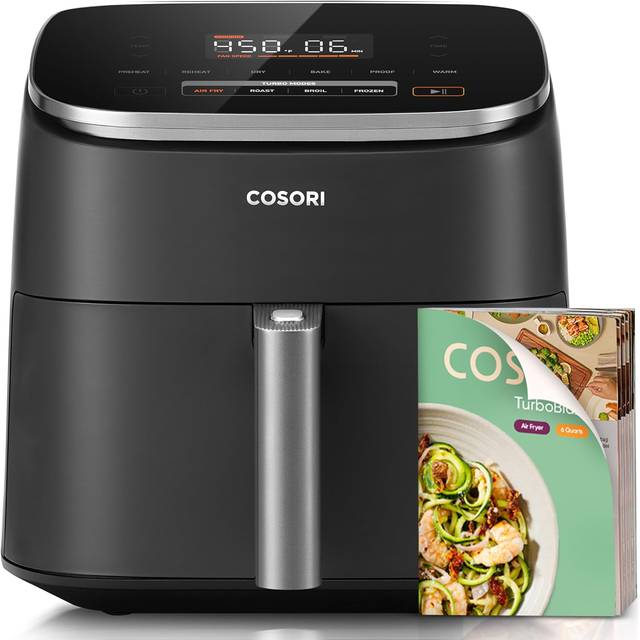
The Cosori TurboBlaze is the machine I reach for when I want chicken breast that doesn't taste like a punishment. It's quiet, sometimes I have to check to see if it's even on, and the ceramic coating releases even melted cheese with ease. The basket is dishwasher-safe, which means cleanup is easy peasy.
My frozen fry test came out crispy in 12 minutes at 400°F. The chicken thigh crisp test passed with flying colors: skin crackling, meat cooked through to 165°F, no pink at the bone. The cake test revealed even heat distribution, no hot spots on the right side like I've seen on other machines.
The touchscreen is intuitive. The preheat feature actually works, which is rarer than you'd think. The recipe book that comes with it is a lovely little book with 24 recipes plus a cooking times chart. I've dehydrated chicken for my dog in it. I've made hard-boiled eggs in it. I've reheated pizza in it and it came out better than it was delivered.
It's not perfect. Small food items like fries can slip between the grates, and the handle button took a bit of getting used to. But for chicken breast, it's the closest thing to a small miracle I've found in a kitchen appliance.
The Amazon Renewed Ninja DZ201 Foodi 8 Quart 6-in-1 DualZone
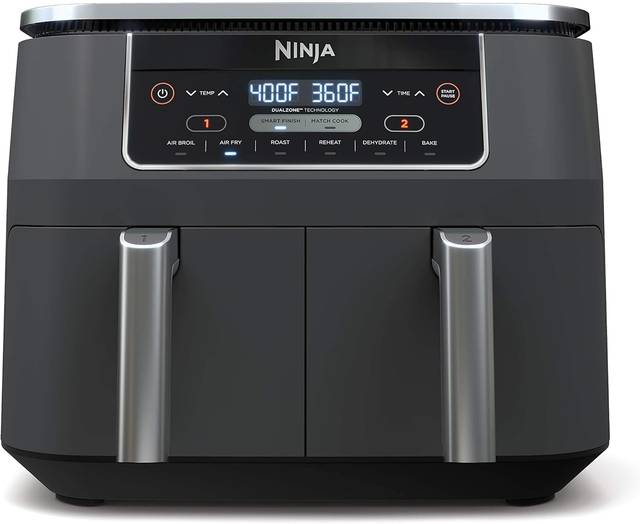
The Ninja DZ201 Foodi is the other machine I've been living with, and it's a different animal entirely. It's 8 quarts, it has DualZone technology so you can cook two things at once, and it costs ~$170. That's twice the price of the Cosori.
For chicken breast, the DualZone feature is genuinely useful. I can cook chicken breast on one side and vegetables on the other, both at different temperatures, and they finish at the same time. That's a real advantage when you're cooking for a HungryMan who wants his taters done at the same moment as his protein.
But here's the thing: the Ninja runs about 10 degrees hot, and it doesn't preheat the way the Cosori does. I've had chicken breast come out at 175°F when I set it for 380, which means I have to adjust my cook times down. That's manageable, but it's an extra variable I don't want when I'm already fighting the clock.
The basket is big, but the usable footprint is what matters. I measured it, and the 8-quart capacity is real, but the basket is shallow, so I have to be careful not to crowd the chicken. Crowding is the enemy of crispiness, and it's also the enemy of even cooking.
The Ninja is a good machine. It's just not the machine I reach for when I want chicken breast that comes out perfect every time. That's the Cosori.
Compared To
The Cosori TurboBlaze and the Ninja DZ201 Foodi are the two machines I've tested most recently, and they couldn't be more different in how they handle chicken breast.
The Cosori is quieter, holds temperature better, and has a preheat feature that actually works. The Ninja is bigger, has DualZone technology, and lets me cook two things at once. But the Ninja runs hot, and that's a problem when you're cooking something as lean as chicken breast.
There's also the Chefman 6 QT, which I bought at random just because it was a good deal. It's a solid budget option, but there are real compromises: the basket just won't go back in sometimes, it takes a minute to get perfectly lined up.
There's no off button, so it just waits to be fired up, and I unplug it usually 'cause it'll blink for a while.
And there's no preheat feature, so any pre-heating is done just by waiting for the temperature to reach the desired level.
For chicken breast specifically, the Chefman runs 15 degrees hot, which means I have to compensate manually. That's doable, but it's not ideal when you're trying to hit 165°F without overshooting.
Design
The Cosori TurboBlaze has a 5-quart capacity, which is enough for about 6 chicken thighs without crowding. The ceramic coating is a real upgrade, and I say that with full sincerity. Even melted cheese comes off with relative ease. The basket is dishwasher-safe, which means I don't dread cleaning it.
The Ninja DZ201 Foodi has an 8-quart capacity, which is bigger, but the basket is shallow and the usable footprint is smaller than the advertised size. The DualZone divider is useful, but it also takes up space.
The Chefman 6 QT is compact, which is good for the counter, but the basket alignment issues are real. I've seen the same reviewer say "I'm so grateful and happy" and "the basket just won't go back in sometimes" in the same review. That's the reality of a budget machine: it's great until it isn't.
Performance
The Cosori TurboBlaze held temperature within 5 degrees of the set point, which is impressive. My chicken breast came out at 165°F when I set it for 380, and it was juicy and tender. The frozen fry test came out crispy in 12 minutes at 400°F.
The Ninja DZ201 Foodi ran about 10 degrees hot, which meant I had to adjust my cook times down. The chicken breast came out at 175°F when I set it for 380, which is overcooked. The DualZone feature is useful, but the temperature drift is a real problem.
The Chefman 6 QT ran 15 degrees hot on the preheat, and since there's no preheat feature, I had to account for the drift manually. The usable footprint is 4.8 quarts, not the advertised 6, and I measured it. Small food items like fries can slip between the grates, so I recommend a liner or a perforated basket insert.
Durability
I've had the Cosori TurboBlaze for over a year now, and the ceramic coating has held up beautifully. I've used it twice a day since I bought it, and it still looks new. That's the machine I reach for when I want to reheat pizza better than it was delivered, make taquitos, or cook coconut shrimp from frozen in 8 minutes.
The Ninja DZ201 Foodi is newer to my kitchen, but it's held up well so far. The non-stick coating is intact, and the basket slides in and out smoothly.
The Chefman 6 QT has a cheaper feel to it. The basket alignment issues have gotten worse over time, and I'm not confident it would survive a move. But for the price, it's a reasonable trade-off.
Value
The Cosori TurboBlaze costs ~$85 on Prime Day, and I've used it twice a day since. That's pennies per meal, and it replaced a toaster oven that burned everything and a microwave that made leftovers soggy. The math matters.
The Ninja DZ201 Foodi costs ~$170, which is twice the price. The DualZone feature is useful, but I'm not sure it's worth the premium for chicken breast alone.
The Chefman 6 QT is the budget option, and it's a good deal. But you get what you pay for. The basket alignment issues, the lack of an off button, and the missing preheat feature are real compromises.
Should You Buy It?
If you want chicken breast that comes out juicy and tender every time, buy the Cosori TurboBlaze. It's quiet, it holds temperature, and the preheat feature actually works. It's the machine I reach for when I'm cooking for my HungryMan or my 87-year-old mom, and it's the machine I've bought as a gift three times.
If you need to cook two things at once, the Ninja DZ201 Foodi is worth considering, but be prepared to adjust for the temperature drift. And if you're on a tight budget, the Chefman 6 QT will work, but you'll have to work around its quirks.
What I'm Testing Next
I've got a batch of new machines coming in this month, including a few budget models I've been asked about. I'm running my standard battery of tests on each one: the frozen fry test, the chicken thigh crisp test, the cake test, and the 30-day daily-use trial. I'll update this post when I have the results.
One last thing: spend the ~$11 for the magnetic strips that hold the paper liner in place. Otherwise it really slides around. And do not put a paper liner in the basket during PreHeat. That's a fire risk, and I've seen people blame the machine for a fire that was really a liner error. God Bless, and let your food-freak flag fly.