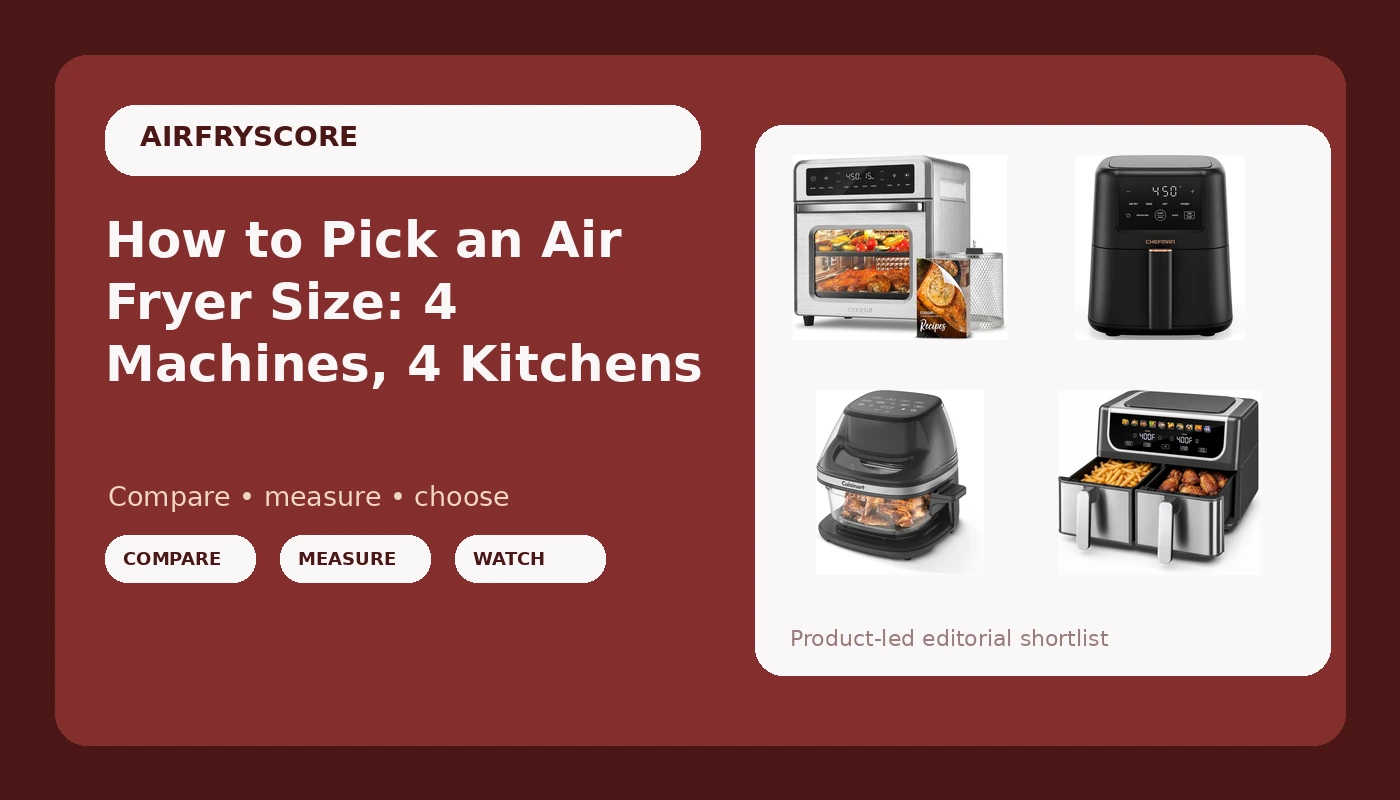
Air fryer size and capacity is the specification shoppers read first and understand least. The number on the box describes the volume of a basket or cavity, not the amount of food that will actually crisp inside it, and two machines with identical quart ratings can behave very differently once the drawer is full. The four models below cover the range that matters in a real kitchen: a dual-basket 9.5-quart unit, a 13-quart oven-style machine with a rotisserie, a slim 3.5-quart compact built for narrow counters, and a 4-quart model with a glass basket and a clear viewing window. This article explains what those numbers mean, what they leave out, and how to match one of these four to the way you actually cook.
Related: Air Fryer Capacity vs Counter Space: What Fits Where →
Quick answer
Match the machine to the largest single meal you cook on a normal weeknight, not to the biggest number that fits on your counter. If you routinely cook two different foods at once, a dual-basket design such as the OLIXIS Dual Air Fryers with 2 Baskets 9.5 Quarts Large Airfryer 10-in-1 is the most direct answer. If you want oven-style versatility with a rotisserie and included accessories, look at the Cosori Air Fryer Oven, 13QT, 11-in-1, Rotisserie, Max 450°F, 6 Accessories. If counter space is the constraint, the Chefman Compact Air Fryer 3.5 QT is the narrow-footprint pick, and the Cuisinart Air Fryer with its glass basket and ClearView window suits anyone who wants to watch food cook without pulling the basket out. No machine here is labeled the fastest, quietest, or best, because the listings do not establish those distinctions.
Four useful options
| Model | Best fit | What stands out |
|---|---|---|
| OLIXIS Dual Air Fryers with 2 Baskets 9.5 Quarts Large Airfryer 10-in-1 | Cooking two foods at once for a household | Two baskets and a 9.5-quart total capacity |
| Cosori Air Fryer Oven, 13QT, 11-in-1, Rotisserie, Max 450°F, 6 Accessories | Oven-style cooking and rotisserie | 13-quart cavity, 11-in-1 functions, six accessories |
| Chefman Compact Air Fryer 3.5 QT | Small kitchens and one or two people | Slim, narrow footprint and a dishwasher-safe ceramic basket |
| Cuisinart Air Fryer, Glass Basket & ClearView Window, 5 Functions, 4 Qt | Watching food as it cooks | Glass basket, clear window, 4-quart capacity |
The two-basket option: OLIXIS Dual Air Fryers with 2 Baskets 9.5 Quarts Large Airfryer 10-in-1
The trade-off is footprint and cleanup. A dual-basket machine occupies more counter than a single drawer of similar total volume, and you are washing two baskets and two crisping plates instead of one. It is also worth reading the per-basket capacity rather than the combined figure, because 9.5 quarts split in two gives you two drawers that are each smaller than a single large basket. For batch cooking, meal prep, or feeding a family that wants two components ready at the same time, that split is the feature.
The oven-style option: Cosori Air Fryer Oven, 13QT, 11-in-1, Rotisserie, Max 450°F, 6 Accessories
This format asks for more vertical clearance than a drawer machine, and it needs room for the door to swing. Cleanup means racks, a drip tray, and a rotisserie rod rather than one basket, so consider whether you will actually hand-wash those parts or whether they fit your dishwasher. In exchange, a rack-based cavity gives you flat, stackable cooking surfaces that suit foods a deep basket handles awkwardly.
The small-kitchen option: Chefman Compact Air Fryer 3.5 QT
The honest limitation is batch size. A 3.5-quart basket handles a single portion or two comfortably and gets crowded fast beyond that. Overloading it does not make dinner faster, it makes it steam, and you end up cooking in two rounds anyway. For one or two people, or for a kitchen where the alternative is no air fryer at all, that trade is reasonable. For a family of four eating the same food at the same time, it is the wrong shape of machine.
The see-through option: Cuisinart Air Fryer, Glass Basket & ClearView Window, 5 Functions, 4 Qt
A glass basket is heavier than a coated metal one and deserves care when it is hot or wet, and it is worth checking the manufacturer's dishwasher guidance before you assume it can go in with the plates. Four quarts sits between the compact Chefman and the larger dual-basket and oven units, which makes it a sensible middle choice for two or three people who cook modest portions.
Prices and availability may change. Product images, names, and retailer links are matched to verified listings. No current price, rating, stock status, or measured result is stated here without current evidence.
Why the quart number is not the whole story
The quart figure describes volume, and volume is not the same as usable cooking surface. A deep, narrow basket can hold fewer wings in a single layer than a shallower, wider one, because the food has to sit flat with space around it for hot air to move. This is the difference between box liters and what I call usable footprint: the actual flat area inside the basket after the walls, the handle recess, and the maximum fill line.
Shape matters just as much. A round pull-out basket encourages you to pile food in the center, which is exactly where airflow is weakest. A rectangular or rack-based cavity lets you spread food flat. Two baskets change the math again, because 9.5 quarts split across two drawers gives you two smaller footprints rather than one big one.
Fill lines exist for a reason. Almost every manufacturer prints a maximum level, and it is usually well below the rim. Food above that line blocks the fan path, traps moisture, and produces pale, soft results that people blame on the machine rather than the load. If your fries come out soggy, the first thing to change is how much you put in, not the temperature setting.
What actually drives crispness
Crispness comes from moving hot, dry air across the surface of food, and that is a function of airflow rather than wattage. A high-wattage element with a weak fan or a blocked intake will brown unevenly and leave a hot spot in one corner, while a more modest element paired with a well-designed convection path can cook more evenly. When you compare machines, look at the basket perforation pattern, the fan placement, and how much clearance the design leaves around the food.
Temperature matters next. A maximum of 450°F, which two of these models state, gives you headroom for frozen foods and for finishing, but the maximum is not the same as accuracy. A machine that drifts far from the set temperature will burn the outside of a cake before the center sets. That is why the same recipe can work in one fryer and fail in another at the identical setting, and why a cheap oven thermometer is a reasonable first purchase with any new unit.
Surface moisture matters too. Patting food dry, using a light oil coating rather than a pour, and leaving space between pieces all do more for browning than any preset button. Presets are starting points built around average foods, not calibrated instructions for your specific dinner.
- Measure the counter space, including clearance above the machine and room for the door or drawer to open.
- Count how many people you cook for on a normal weeknight, then choose capacity from that meal rather than from your biggest holiday cook.
- Decide whether you need two temperatures at once, which is the real reason to buy a dual-basket machine.
- Choose the format that suits your food: a deep pull-out basket for fries and wings, a rack-based oven cavity for rotisserie and flat items.
- Look at the parts you will clean every time, and confirm with the manufacturer whether the basket is dishwasher-safe.
Practical guidance
- Fill to the printed maximum line, not to the rim, and cook in two batches instead of one crowded one.
- Shake or turn food halfway through so the pieces that started at the back of the basket get equal time in the airflow.
- Preheat when a recipe assumes it, especially for cakes and anything with a batter.
- Measure the spot before you buy, in all three dimensions, because a machine that fits the width can still fail the overhead clearance.
- Wash the basket promptly and follow the coating instructions, since abrasive pads and long soaks are what shorten the life of a nonstick surface.
Which option should you choose?
Choose the OLIXIS Dual Air Fryers with 2 Baskets 9.5 Quarts Large Airfryer 10-in-1 when you regularly cook two components at once for a household, or batch cook for the week. Choose the Cosori Air Fryer Oven, 13QT, 11-in-1, Rotisserie, Max 450°F, 6 Accessories when you want oven-style cooking, a rotisserie, and flat rack surfaces. Choose the Chefman Compact Air Fryer 3.5 QT when counter width is tight and you cook for one or two people. Choose the Cuisinart Air Fryer, Glass Basket & ClearView Window, 5 Functions, 4 Qt when you want to watch food brown through a window and prefer a glass basket.
Capacity, function counts, and maximum temperatures above are as stated in the product listings. No measured temperature, cook time, or durability result is reported here for these units, and prices and availability change.
The bottom line
The right air fryer size is the one that fits your normal dinner and your actual counter. If two foods at once is your pattern, the dual-basket OLIXIS is the most direct match. If you want rotisserie and rack cooking, the Cosori oven-style unit covers more techniques in one footprint. If space is scarce, the Chefman compact keeps a narrow footprint and a dishwasher-safe basket. If you want to see the food while it cooks, the Cuisinart glass basket gives you that. Whichever you pick, buy for the meal you make most often, leave room around the food, and check the current Amazon price before you commit.