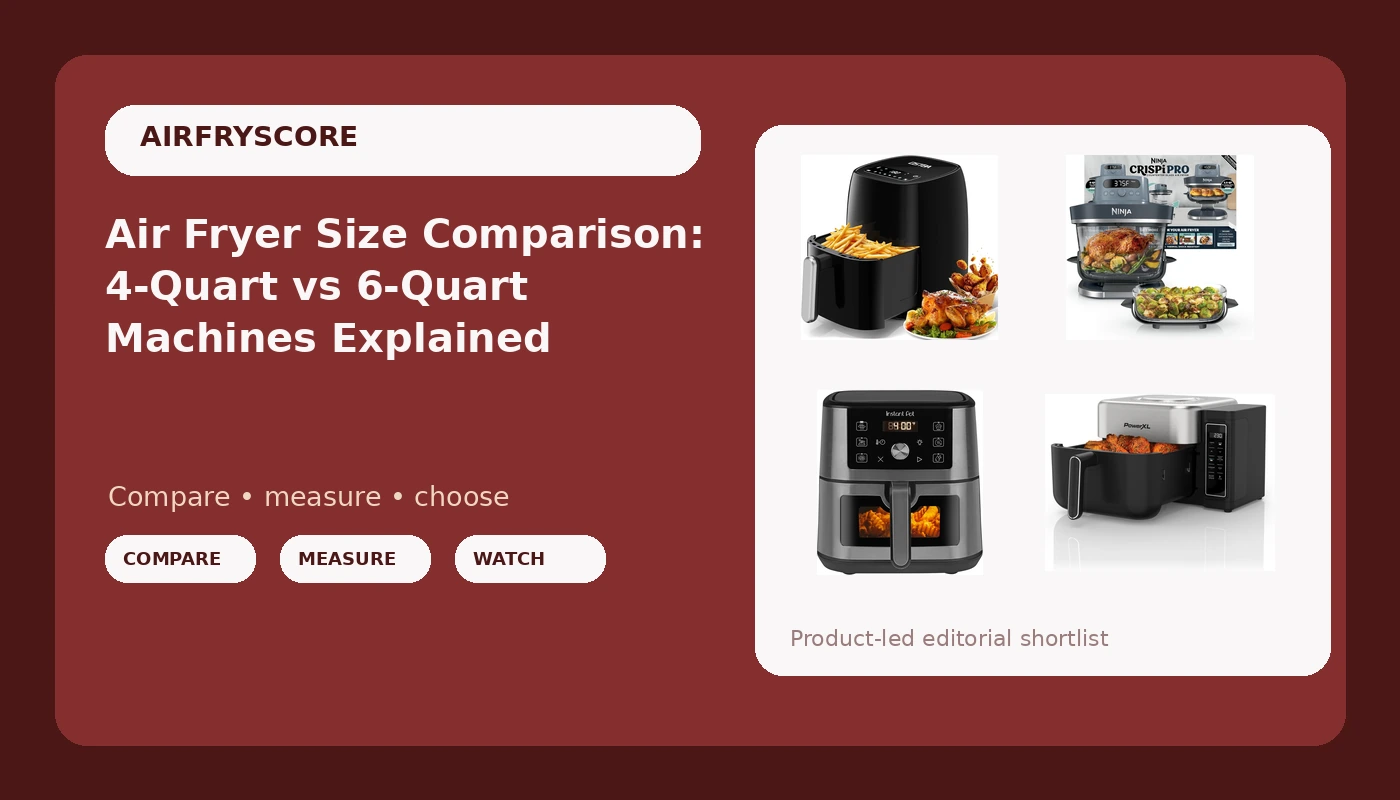
Walk down the air fryer aisle, in a store or in a search results page, and the numbers start to blur. Boxes advertise 4 quarts, 4.5 quarts, and 6 liters, while others lead with "6-in-1" and a photo of a basket that may or may not hold a whole chicken. None of those numbers tells you how much food actually fits in a single layer, and that is the number that decides whether an air fryer becomes your weeknight default or a cabinet ornament. This air fryer size comparison breaks down what capacity ratings really mean, where the four machines below land, and how to match a basket to the way you actually cook.
Related: Air Fryer Basket Sizes Explained: Quarts, Layers, and Real Capacity →
Quick answer
Capacity ratings describe the basket's outer volume, not the flat cooking surface you can load. A 4-quart machine is generally sized for one or two people and single-batch sides, while a 6-quart or 6-liter machine is built for family portions, whole proteins, and layered cooking. Decide capacity first, then choose the control style, basket material, and function count that fit your kitchen.
Four sizes and formats worth considering
| Model | Best fit | What stands out |
|---|---|---|
| OSTBA 4.5QT Air Fryer | Budget-minded small households | LED touch screen, 6 presets, dishwasher safe nonstick basket |
| Instant Pot 4QT VORTEX 6-in-1 Mini Air Fryer | Tight counters and multi-purpose cooking | Stainless steel body, 4-quart basket, six cooking functions |
| PowerXL Airmax Air Fryer 6L | Families cooking larger portions | 6-liter capacity with 4 automatic functions |
| Ninja Crispi Pro Glass Air Fryer | Buyers who want a glass cooking vessel | 6-in-1 design with a glass basket in a Cyberspace finish |
Compact starter: OSTBA 4.5QT Air Fryer
The trade-off with any 4.5-quart basket is batch size. You can cook a solid portion of fries or a couple of chicken thighs, but a whole chicken or a full sheet of vegetables for four people usually means two rounds. If you mostly cook for one or two, that is a feature rather than a flaw, because a smaller basket heats up faster and takes up less counter space. If you regularly feed a family, this format will frustrate you by month two.
Small-space multi-cooker: Instant Pot 4QT VORTEX 6-in-1 Mini Air Fryer
The case for this one is versatility per square inch. Baking and dehydrating are functions a plain air fryer does not offer, so if you want one appliance to cover reheating leftovers, crisping vegetables, and finishing a small bake, the function list is doing real work. The cost is the same as any 4-quart basket: it is a one or two person machine, and the multi-function panel adds settings you will need to learn rather than a single dial.
Large-batch option: PowerXL Airmax Air Fryer 6L
Big baskets come with a trade-off that the box never mentions: footprint. A 6-liter machine takes up noticeably more counter depth and height, and it needs clearance above it for the exhaust. It also rewards planning. Cooking two portions in a 6-liter basket uses more energy than cooking them in a 4-quart, because you are heating a larger cavity for the same amount of food. Buy the capacity you will use most weeks, not the capacity you imagine using at a holiday.
Premium glass basket: Ninja Crispi Pro Glass Air Fryer
Glass is heavier than a coated metal basket, and it needs to be handled like glass: no tapping it against the sink edge, no sudden temperature shocks. In exchange you get visibility, which is genuinely useful when you are learning a new machine and do not yet know how your food browns at a given setting. This is the option to weigh against a straightforward basket if durability and transparency matter more to you than a lower entry point.
Prices and availability may change. Product images, names, and retailer links are matched to verified listings. No current price, rating, stock status, or measured result is stated here without current evidence.
What the quart and liter ratings actually measure
Air fryer capacity is measured as the volume of the basket, and that volume includes the walls, the corners, and the space above the food. What you can actually load is the flat cooking surface at the bottom, and that is a much smaller number. This is why two machines labeled 4 quarts can feel completely different: a wide, shallow basket holds more usable area than a narrow, deep one, even when the printed volume matches.
Shape matters as much as volume. A square or rectangular basket wastes less space than a round one, because round baskets leave gaps at the corners when you lay out food. A basket with a removable crisper plate sits the food higher, which improves airflow underneath but also eats into the usable depth. None of this appears on the box, which is why a capacity number alone is a weak buying signal.
The practical consequence is that stacking is the enemy. Air frying works by moving hot air across the surface of the food. If pieces overlap, the covered parts steam instead of crisping, and you end up with uneven results that look like a machine problem when it is really a loading problem. Any capacity rating assumes a single layer, so the honest way to read a spec sheet is to ask how much food fits in one layer, then decide whether that is enough for the people you cook for.
Material adds a second variable. Nonstick-coated baskets are light and easy to clean but depend on how well the coating holds up. Glass vessels are heavier and let you see the food, which shortens the learning curve. Stainless steel bodies tend to be sturdier and often come with a broader function set. None of these is automatically better; they are trade-offs against weight, price, and how you clean up.
How to match capacity to your household
Start with the number of people eating at once, not the number of people in the house. One or two portions fits comfortably in a 4 to 4.5-quart basket. Three or four portions, or a whole protein like a chicken, generally needs 6 quarts or 6 liters. If you routinely cook once and eat twice, buy the smaller basket and accept two batches rather than paying for capacity you use twice a year.
Then work through the rest in order:
- Count the portions you cook most weeknights, and size the basket to that number.
- Measure your counter depth, width, and the clearance under your upper cabinets before choosing a 6-liter machine.
- Decide which functions you will actually use: air fry alone, or bake, broil, and dehydrate as well.
- Choose the basket material you are willing to maintain, whether that is a dishwasher-safe nonstick basket, a stainless body, or a glass vessel.
- Check the control style you will live with daily, since a touch panel and a set of automatic functions ask for different habits than a single dial.
Practical guidance before you buy
- Read the capacity as a maximum, then mentally cut it in half for the food you can actually crisp in one layer.
- Treat a dishwasher-safe basket as a real feature only if you will genuinely run it through the dishwasher rather than hand-washing it to protect the coating.
- Prefer a wider, shallower basket over a narrow, deep one when the printed capacities match.
- Account for the machine's footprint and rear and top clearance, because air fryers need room to exhaust hot air.
- Match the function count to your cooking: a 6-in-1 earns its panel only if you bake, broil, or dehydrate, not just reheat fries.
- Expect to shake or turn food partway through regardless of basket size, since even airflow is never perfectly even.
Which option should you choose?
Choose the OSTBA 4.5QT Air Fryer when you want a straightforward touchscreen basket for one or two people and cleaning convenience is a priority. Choose the Instant Pot 4QT VORTEX 6-in-1 Mini Air Fryer when counter space is tight and you want air frying plus baking, broiling, and dehydrating in one compact stainless machine. Choose the PowerXL Airmax Air Fryer 6L when you regularly cook for three or more and need a basket wide enough for a true single layer. Choose the Ninja Crispi Pro Glass Air Fryer when you would rather watch your food cook through a glass vessel and you are willing to handle and store something heavier.
One caveat applies to all four: the capacity figures and function lists above come from the manufacturer listings, not from a measured cooking surface. A basket's usable area is always smaller than its rated volume, and how a specific machine performs with your recipes depends on airflow, loading, and how you use it.
The bottom line
The air fryer size comparison that matters is not 4 quarts versus 6 quarts on a box. It is how much food you can spread in a single layer, on the counter space you actually have, in a vessel you are willing to clean. Smaller 4 to 4.5-quart machines like the OSTBA and the Instant Pot Vortex Mini suit one or two people and fit tight kitchens, while a 6-liter basket like the PowerXL is the one that lets a family cook dinner in one pass. The Ninja Crispi Pro answers a different question, trading weight for a glass vessel you can see through. Pick the capacity first, then let material, functions, and controls settle the rest.