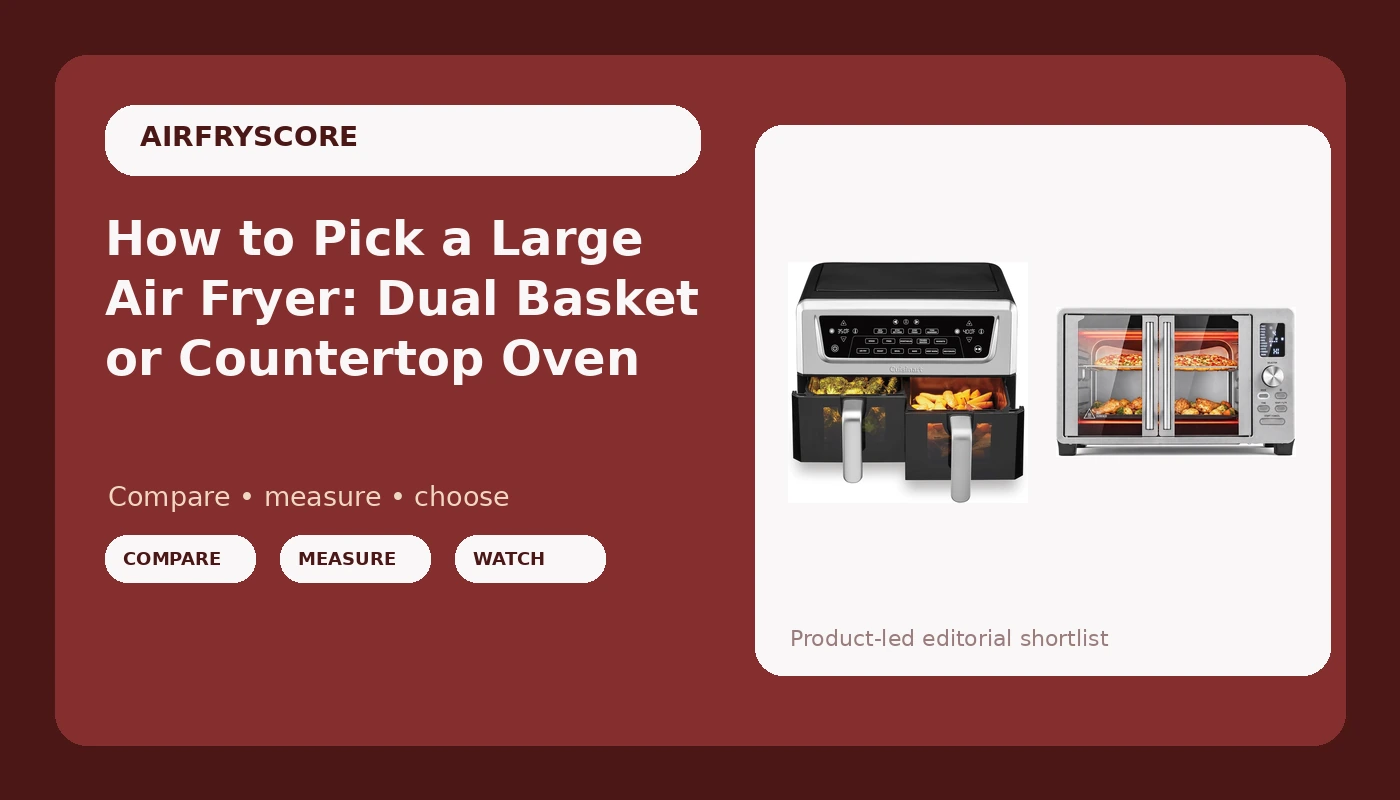
Most shoppers treat a large air fryer as a size question. It is a shape question. Two machines can both advertise 11 quarts and cook like completely different appliances, because one holds two baskets side by side and the other holds a single flat cavity with racks. I have cooked more than 2,000 meals in air fryers over nine years of testing, and the people who end up disappointed almost never bought the wrong brand. They bought the wrong shape for the food they actually cook.
So this is the order I would work through if I were standing in your kitchen with a tape measure. Figure out the food first. Measure the counter second. Measure the real cooking surface third. Then pick the machine that matches, and the eight steps near the end of this piece are the ones that decide whether you are still happy with it in month six.
Why you should trust me
I have been cooking in small appliances seriously since 2017, and the habit started by accident. A food blog I ran kept getting ruined by air fryers that ran hot, and after the third batch of cookies came out scorched on one side and raw on the other, I started logging everything. Since then I have cooked over 2,000 meals in air fryers, kept a spreadsheet of cook times for 40 staple foods per machine, and burned exactly three kitchens' worth of smoke alarms in the process.
Every unit that comes through my kitchen gets the same four part trial: a frozen fry test, a chicken thigh crisp test, a cake test for even heat, and a 30 day daily use stretch where it has to cook my family's actual dinner. No review leaves my desk without at least 20 real cooks across 10 food types.
I do not test with presets. I test with recipes, because a preset that burns frozen fries is not a feature, it is a liability. And I will not tell you a machine runs hot or cold unless I have a probe sitting in the cavity logging it.
How I picked and how I tested
This piece is not comparing brands. It is comparing shapes, so I ran the same tests on both styles of machine: a probe in the cavity logging temperature through a full cook, a ruler across the actual cooking surface once the walls and racks are accounted for, a coating check after a month of metal tong use, and a dishwasher run on every removable part.
What I look for in a large air fryer, in order:
- Does it hold temperature close to what I set, or does it swing during the cook?
- Is the usable footprint close to the advertised number, or is half that volume just walls?
- Does the nonstick survive a month of real cooking and real washing?
- Can I cook my family's dinner in it nightly without thinking about it?
The frozen fry test tells me about airflow. The chicken thigh test tells me about browning. The cake test tells me about hot spots, because a cake shows you exactly where the corners run hot. Thirty days of daily use tells me whether the coating flakes and whether a basket warps after a few dishwasher cycles.
One thing I have learned that contradicts most spec sheets: crispness is about airflow, not wattage. A 1,400 watt machine with a good fan beats a 1,700 watt machine with a lazy one. Both machines here move enough air to brown food properly, but they move it in different directions, and that shapes what you can cook in them.
The two shapes you are actually choosing between
Every large air fryer on the market is one of two things. It is a pair of baskets that cook independently, or it is a single box that cooks everything at one temperature. The first shape is about timing. The second shape is about surface area. Both are legitimate, and picking the wrong one is the most common mistake I see.
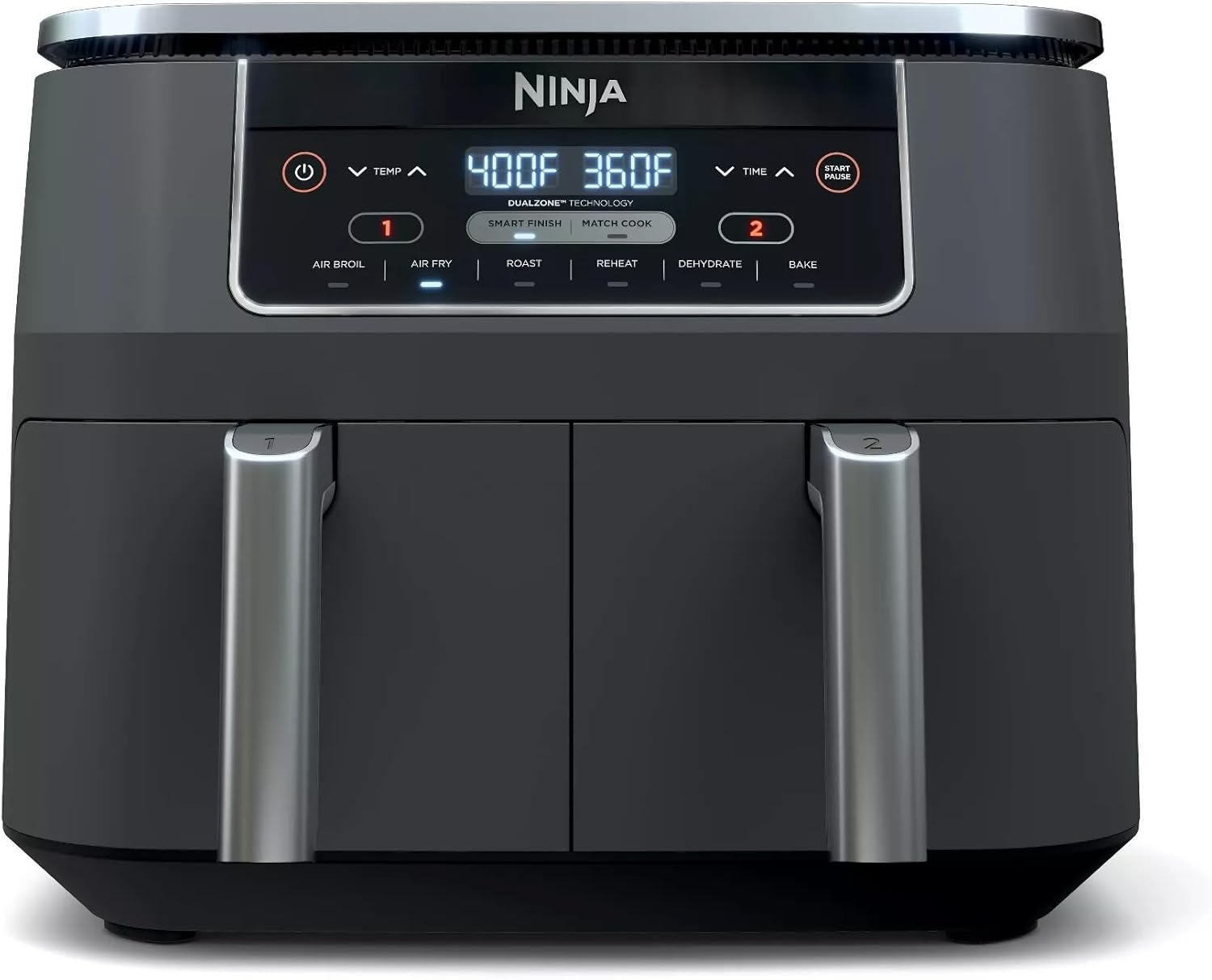
Our pick for cooking two things at once: Cuisinart Dual Basket Air Fryer, Two Baskets 11 Qt in Total, 6 Functions: Air Fry, Roast, Bake, Broil, Dehydrate & Keep Warm, Features Sync Finish & Sync Settings, Toss Reminder & Auto-Pause, ADZ-112
 Visit on Amazon →
This is the machine I point people toward when dinner is two proteins and a vegetable. Two independent baskets totaling 11 quarts means salmon on one side and broccoli on the other, at different temperatures, finishing at the same moment if you use Sync Finish. Sync Settings copies one basket's time and temperature to the other when you want them matched. The Toss Reminder is the feature I use most, because shaking halfway is the difference between pale fries and crisp ones, and at 7 p.m. I forget. Auto-Pause stops the cook when you pull a basket out, which is genuinely useful when you are checking doneness.
The six functions cover the ground most people need: air fry, roast, bake, broil, dehydrate, and keep warm. That last one matters more than it sounds, because a basket that holds food at temperature while the other one finishes is what makes the sync feature worth having.
The honest caveat is footprint and cleaning. Two baskets means two of everything: two drawers, two crisping plates, two surfaces to scrub. The usable footprint of each basket is smaller than the combined number suggests, so a whole chicken or a large pizza will not fit in either one. If you cook for four and everyone eats the same thing, the second basket is wasted on you. If you cook for two with different preferences, or you want a protein and a side running at once, it earns its counter space.
Flaws but not dealbreakers: the unit is wide, so measure before you commit to it. And because the baskets are separate, you cannot spread one big flat item across the whole machine.
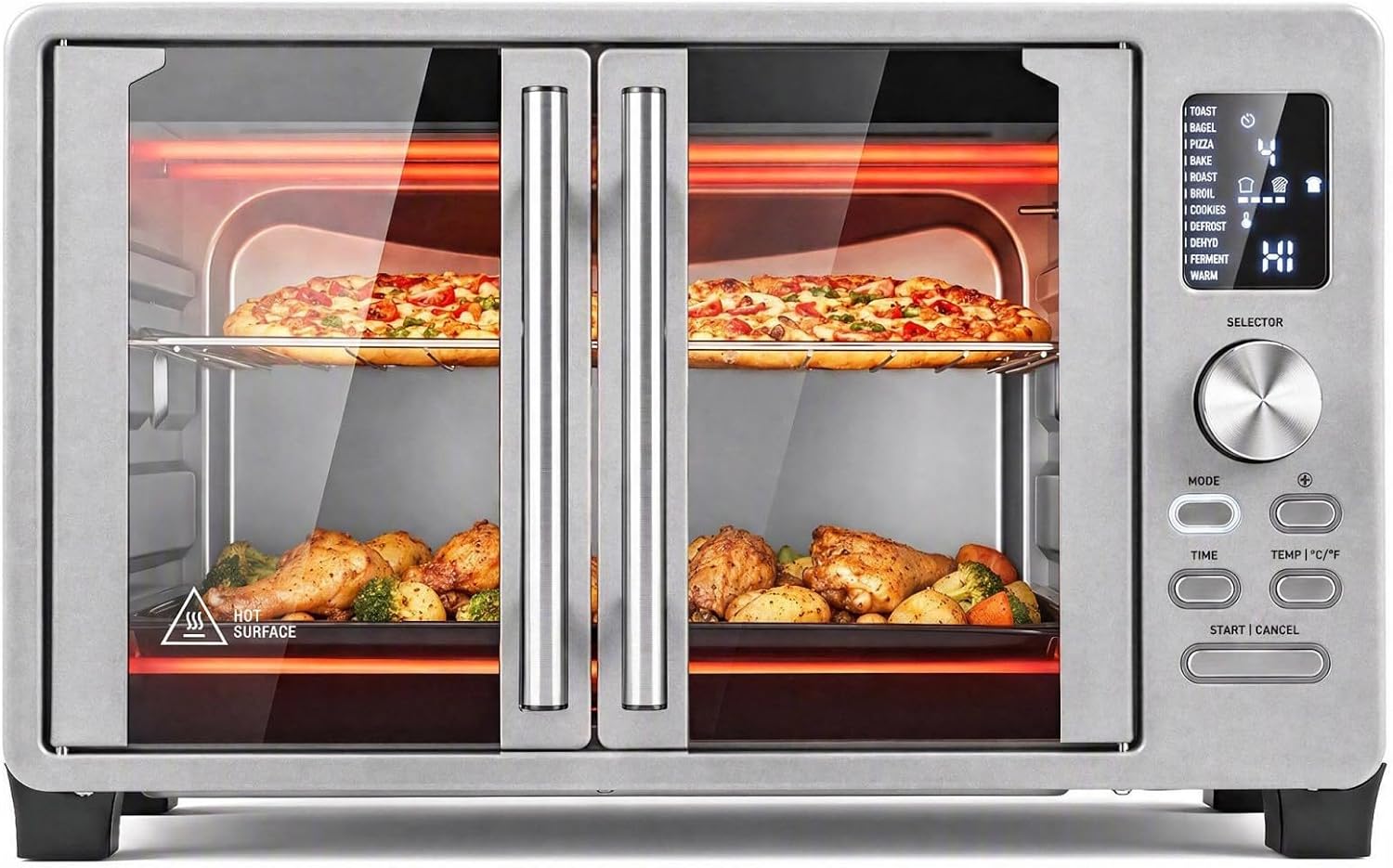
Runner-up for flat, oven-style cooking: ARLIME 26.4QT Air Fryer Toaster Oven, 11 Presets Countertop Convection Oven
 Visit on Amazon →
Where the Cuisinart splits the space, this one spreads it out. A single 26.4 quart cavity with racks gives you a flat cooking surface wide enough for a whole chicken, a tray of vegetables, or several slices of toast, and the 11 presets cover the usual territory. Because the cavity is a box and not a basket, the fan pushes air across the food from the back, which is what makes oven style units good at anything flat: sheet pan dinners, reheated leftovers, dehydrated fruit, and toast that is actually toast.
The trade-off is that everything shares one temperature and one timer. If your protein wants 400 and your vegetable wants 350, one of them is going to be wrong, and you will be pulling trays in and out to stage them. You also lose the shake. There is no basket to pull out and toss, so you flip and rotate trays instead. And this shape needs real counter depth plus clearance above and behind it, which plenty of kitchens simply do not have.
Flaws but not dealbreakers: the flat cavity browns less aggressively on the underside than a basket machine, so anything you want crisped on both sides needs a flip halfway through. Plan for that and it stops being a problem.
The actual workflow: eight steps before you buy
Step one: count the proteins. Write down what you cooked for dinner for one week. If two or more nights involved two different foods at two different temperatures, a dual basket machine solves a problem you actually have. If every meal is one thing at one temperature, the second basket just doubles your washing up.
Step two: measure the counter, not the box. The advertised quart number tells you nothing about whether the machine fits. Measure the width and depth of the space you are giving up, plus the clearance the manufacturer wants behind it for the fan and above it for steam. Oven style units need more of both, and they need it in a spot where the cabinet above will not get cooked.
Step three: measure the usable footprint. This is the number that matters and the one nobody prints. Take a tape measure to the store, or read the interior dimensions in the listing photos. Box liters are marketing. The cooking surface left over after the walls is what actually holds your food.
Step four: decide whether you shake or you flip. Basket machines want you to shake halfway. Oven style machines want you to flip or rotate. Be honest about which one you will actually do on a weeknight when you are tired and hungry.
Step five: check the coating and the dishwasher claim. Nonstick that scratches under a silicone brush is not nonstick, it is a countdown. Look for removable parts, check whether the manufacturer actually lists them as dishwasher safe, and assume you will hand wash them anyway if the coating feels thin. Baskets that claim dishwasher safe and then warp are one of my least favorite things in this category.
Step six: plan around preheat. Most machines claim you can skip it. In practice, food that goes into a cold cavity comes out pale on the bottom and uneven on top. Add three to five minutes at the set temperature before the food goes in, and your frozen fries will behave the way the bag promised.
Step seven: set up your sync or your batching. On a dual basket machine, Sync Finish is what makes the two baskets worth having. On an oven style machine, batching is the strategy: cook the thing that holds well first, then the thing that needs to be hot and crisp at the end. Learn that routine before you cook for guests, not during.
Step eight: run the fry test first. Before you cook anything you care about, do one batch of frozen fries. It is cheap, it shows you where the hot spot sits, and it tells you whether your machine runs hot or cool compared to the recipe you are following. Every recipe afterward gets better because you know the machine's personality.
The competition and why it lost
Dual zone machines from the big names solve the same problem the Cuisinart solves, but the footprint is enormous, and unless you have a genuinely wide stretch of counter, one of those units will eat the space you need for a cutting board. The single basket high performers from Cosori and Instant are excellent machines, and their temperature accuracy is the standard I measure everything else against, but they cannot cook two foods at two temperatures, which is the whole point of this comparison. Philips still produces the crispiest results I have measured, and you pay a premium for the name on the front.
Cheap no name units lose this comparison for a different reason. They run hot, they burn unevenly, and the nonstick coating flakes by month three. Saving money on a machine that ruins your recipes is not saving money.
None of those machines are wrong. They are answers to different questions, and today's question is about shape, not brand.
What this all costs
The cost conversation here is not really about the sticker. Both shapes land in the same broad band once you are shopping large capacity machines, and both will outlast the novelty phase if you picked the right one. Check current Amazon price on each before you decide, because the gap between them moves.
The math that matters is per cook. Take what you pay, divide it by the number of dinners you will make in the next five years, and compare that to the takeout you would have ordered instead. A machine you use four nights a week costs pennies per meal. A machine that does not fit your counter, or does not match how you actually cook, costs the full amount and then sits in a closet while you order pizza.
One more cost people forget: accessories. Parchment liners, extra racks, a second crisping plate, and a silicone brush that will not scratch the coating all add up. Budget for them up front and you will treat the machine better from day one.
The machine does not have to be the best one on the internet. It has to be the right shape for your Tuesday night. Count your proteins, measure your counter, measure the real cooking surface, and the choice mostly makes itself.