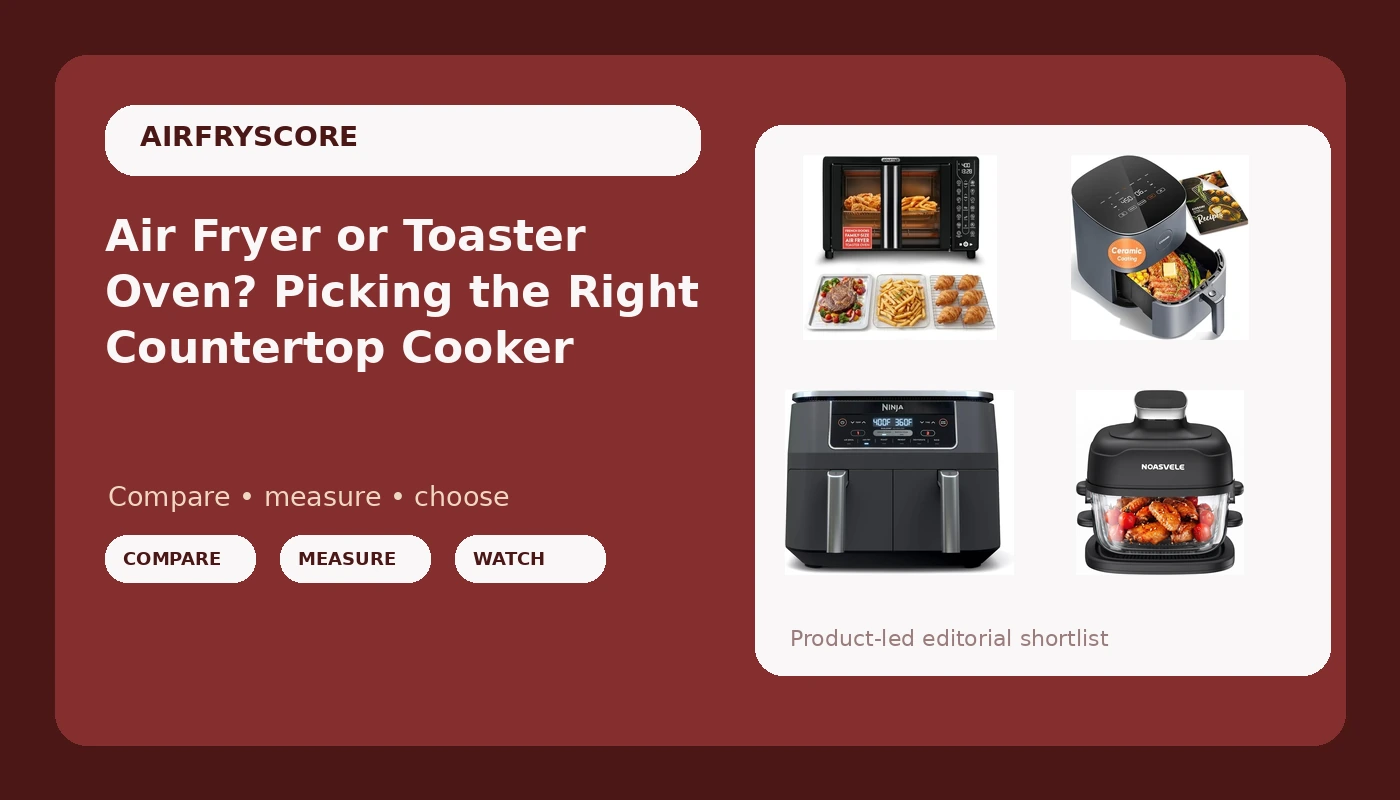
Buying a countertop air fryer used to be simple: pick a size, pick a price, done. The shelf looks different now. A single-basket air fryer, a dual-basket machine, a glass air fryer with a crisper plate, and a six-slice toaster oven all sit in the same aisle and all quietly imply they can replace each other. They cannot. Each shape solves a different problem, and the specification that matters most is rarely the one printed largest on the box. This guide compares four current options and explains what their listed features actually mean for weeknight cooking, so you can match the appliance to the food you make rather than to the wording of the listing.
Related: How Basket Size Changes What You Can Actually Cook →
Quick answer
Match the shape of the appliance to your cooking, not to the number of functions on the label. A single-basket air fryer such as the Cosori Air Fryer Pro LE 5 Qt covers the most common jobs with the fewest decisions, because there is one cooking zone and one temperature to manage. A dual-basket machine such as the Ninja DZ201 Foodi 2-Basket Air Fryer is the practical pick when two foods need different times or temperatures at the same moment. A glass air fryer with a crisper plate is the option to consider if you want to watch food as it cooks. A six-slice toaster oven such as the Gourmia is the better shape when toast, bagels, and oven-style baking take up more of your routine than basket frying does.
Four useful options
| Model | Best fit | What stands out |
|---|---|---|
| Cosori Air Fryer Pro LE 5 Qt | One or two people cooking one dish at a time | 5-quart single basket, nine cooking functions, ceramic coating, shake reminder |
| Ninja DZ201 Foodi 2-Basket Air Fryer | Cooking two foods at once | Two independent baskets with DualZone technology, 8 quarts total, six cooking functions, renewed unit |
| Glass Air Fryer with Crisper Plate, 4-in-1 | Watching food as it cooks | Glass cooking vessel, crisper plate, four cooking functions |
| Gourmia Toaster Oven, 6-Slice | Toast, bagels, and oven-style baking | Six-slice capacity, digital display, countertop oven format |
The everyday single basket: Cosori Air Fryer Pro LE 5 Qt
A single basket is not a compromise so much as a simplification. Everything in the basket shares one temperature and one timer, which is exactly what most weeknight cooking needs: frozen fries, chicken thighs, roasted vegetables, reheated leftovers. The ceramic coating matters for a different reason. Coatings take the wear in an air fryer, and the softer, slicker ceramic finishes tend to be gentler on the food and on the utensil you use to turn it. The trade-off is sequencing. If the protein and the side need different temperatures, you cook them one after the other and the first one waits. Five quarts is comfortable for one or two people and workable for three, but a family of four cooking a full meal at once will feel the limit of a single zone long before they feel the limit of the volume.
The two-zone option: Ninja DZ201 Foodi 6-in-1 2-Basket Air Fryer
Two baskets solve the sequencing problem directly. Salmon at one temperature in the left zone, broccoli at another in the right, both finishing at the same time, which is the single biggest quality-of-life difference between this shape and a single-basket machine. The costs are real, though. A two-basket unit occupies more counter depth and more cabinet space than its total quart figure suggests, and eight quarts split in two is not the same as eight quarts in one basket: each side has its own walls, its own usable footprint, and its own capacity ceiling for a whole chicken or a large batch of fries. This particular listing is also renewed rather than new stock, so read the condition details on the listing before you decide. That status is a price consideration, not a performance one, but it changes what you are buying.
The see-through option: Glass Air Fryer with Crisper Plate
Most air fryers ask you to open the drawer and guess. A glass body removes the guesswork: you see browning as it happens, which is genuinely useful for anything that goes from pale to burnt in ninety seconds, and it removes the coating question entirely, since there is no nonstick surface to scratch or flake. The crisper plate does the work a basket bottom normally does, lifting food out of the drippings so air can move underneath. The trade-offs are weight and capacity. Glass is heavier than coated metal, so lifting and washing the vessel takes more care, and the four-function count is narrower than the nine-function machines, which matters only if you use those extra modes. Visibility and simplicity are the reasons to choose this shape, not raw volume.
The oven-shaped option: Gourmia Toaster Oven
This is the option people overlook when they shop for an air fryer. A six-slice toaster oven handles the jobs an air fryer handles awkwardly: six slices of toast at once, a sheet of vegetables spread flat instead of piled in a basket, a small casserole, a reheat that does not steam the crust soft. Flat, wide layouts give food more exposed surface, which is why oven-style cooking browns evenly across a batch. What it does not do is circulate air the way a dedicated basket machine does, so the very crisp, fast results that define air frying are less pronounced here. If your cooking is 70 percent toast, bagels, and baked dishes with the occasional batch of fries, the oven shape is the better investment. If it is the reverse, a basket machine earns its counter space.
Prices and availability may change. Product images, names, and retailer links are matched to verified listings. No current price, rating, stock status, or measured result is stated here without current evidence.
Why quoted capacity and usable cooking surface are different numbers
The quart figure on the box is the volume of the vessel, not the area you can actually load. A five-quart basket with sloped walls and a raised crisper plate may give you a cooking surface closer to a small sheet pan, and an eight-quart two-basket machine splits that figure across two chambers that each have their own walls. When you compare machines, compare the flat area at the bottom of the basket and the height above it. Height decides whether a whole chicken or a stacked layer of wings fits. Area decides how much of a single layer of fries you can spread without crowding, and crowding is the most common reason home air fryer results come out steamed and pale instead of crisp. If a listing does not state usable dimensions, look for user photos showing food in the basket. That tells you more than the quart number does.
How temperature, airflow, and presets shape results
Crispness comes from moving air, not from wattage. A machine that circulates well at a moderate wattage will out-brown a higher-wattage unit with a weak fan, because the fan is what strips moisture off the surface and carries heat into the gaps between pieces. Temperature accuracy matters just as much. A machine that drifts far from the set number will burn the outside of a chicken thigh before the inside is done, and no recipe can compensate for that. Presets are convenience labels, not guarantees: they pick a time and temperature for a generic version of a food, and frozen items vary enough in size and moisture that the preset is a starting point at best. Learn the machine's real behavior with a few repeat cooks, then trust your own numbers.
- Decide what you cook most often: single dishes, two-part meals, toast and bakes, or food you want to watch.
- Measure your counter and cabinet space before you look at quart figures, because the footprint is what you live with.
- Check whether the basket, tray, or vessel is dishwasher safe, and whether the coating is one you are willing to hand wash.
- Look at the usable cooking surface and the height above it, not the total volume printed on the box.
- Plan to run two or three test cooks with familiar foods so you learn how the machine actually behaves at your usual settings.
Practical guidance before you buy
- Buy for the meal you cook on a Tuesday, not the meal you cook once a year at a holiday.
- Treat a renewed or refurbished listing as a separate decision from the model itself and read the condition terms.
- Match the number of cooking zones to the number of foods that need different temperatures at the same time.
- Prioritize a coating and a vessel you can clean without dread, because cleaning is what determines how often you use it.
- Leave more clearance around the machine than you think you need, since air fryers and toaster ovens both need room to vent heat.
Which option should you choose?
Choose the Cosori Air Fryer Pro LE 5 Qt when you cook one dish at a time for one to three people and want the fewest settings to manage. Choose the Ninja DZ201 Foodi 2-Basket Air Fryer when two foods regularly need different times or temperatures, you have the counter depth for it, and a renewed unit suits your budget. Choose the Glass Air Fryer with Crisper Plate when seeing the food as it cooks is worth more to you than a higher function count and a lighter basket. Choose the Gourmia Toaster Oven when toast, bagels, and oven-style baking are the bulk of what you make and air frying is the occasional job.
One caveat applies to all four. Nothing here replaces reading the current listing: function counts, included accessories, coating details, and condition can change between production runs, and a renewed unit is not the same purchase as a new one. Check the listing for the specifics that matter to you before you commit.
The bottom line
The four machines here are four different answers, not four versions of the same answer. A single-basket air fryer buys simplicity, a dual-basket machine buys simultaneous cooking at the cost of counter space, a glass air fryer buys visibility and drops the coating question, and a toaster oven buys flat, wide, oven-style capacity at the cost of the fast crisp that defines air frying. Decide which of those trades you actually want, confirm the current details and condition on the listing, and the choice stops being difficult.